How a 5,000-Year-Old City Made a Wetland Buildable
Buried construction layers and modern experiments reveal how ordinary materials helped shape an extraordinary ancient landscape, and why better drainage did not mean ground that could never settle.

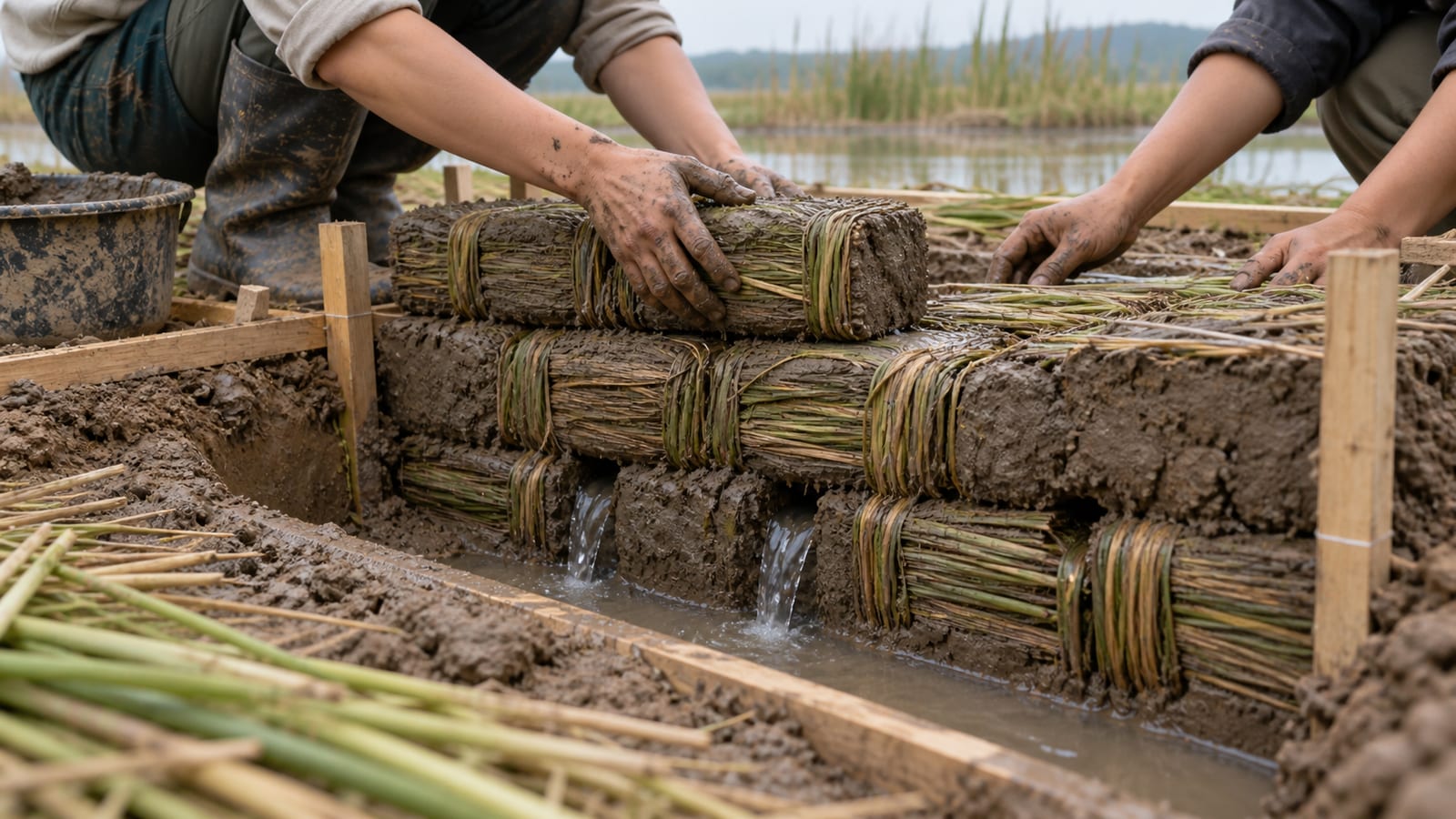
One of Liangzhu's building materials was clay wrapped in grass. Workers stacked the bundles to raise the ground and fill the cores of walls and mounds. The arrangement resembled a sandbag structure, with vegetation doing the wrapping. Wang and colleagues' archaeological study.
Before its builders could put much on the ground, they had to make ground they could use.
Liangzhu developed in eastern China within a Late Neolithic culture dating approximately from 3300 to 2300 BCE. Its remains include monumental earthworks, elaborate jade objects and water-management infrastructure, associated with a society whose economy rested on rice cultivation. UNESCO's site description.
A new study by Huiru Lian and colleagues examines construction at Middle Zhongjiagang, within the city, and Shiqianwei, outside it. Using sediment analysis and microscopic examination of soil, the researchers identify a sequence involving locally obtained foundation material, grass-wrapped clay and processed sediment mixtures in upper layers. They interpret mound building and waterway modification as connected activities. These locations represent only a small portion of Liangzhu's wider earthworks. The new archaeological study.
The paper carries an October 2026 journal issue date and was highlighted by Nature on September 9. It adds evidence about construction methods to a site archaeologists have studied for years. Publisher record, Nature's research highlight.


The wrapping technique was already known. Separate experiments help explain why the arrangement deserves attention.
In research published online in 2025, a Lanzhou University team compared stacks of grass-wrapped clay with stacks of clay alone. Spaces between the wrapped blocks provided drainage routes that remained connected during compression. Under the reported comparison conditions, the wrapped arrangement allowed water to pass through more readily. The consolidation experiment.
The wrapped stacks also compressed more readily during one loading stage and showed more continuing deformation under constant load. Better drainage did not make them incapable of settling. These were laboratory results, not measurements of how an entire ancient mound performed. The experiment's reported findings.
That gives the bundles an extra dimension: the spaces between them mattered, too. Understanding the structure means looking at how its pieces fit together, as well as what they were made from.
Grass and clay were part of a broader repertoire. Excavations of Liangzhu's city walls revealed stone bedding roughly 40-60 meters wide. Researchers interpret these bases as a way to establish usable foundations on muddy ground while allowing drainage through the spaces between stones. That evidence comes from walls; it does not establish a recipe followed beneath every mound. The stone-foundation study.
Across the landscape, Liangzhu's builders also constructed dams, levees and channels. Earlier archaeological research connects this infrastructure with flood management, rice farming and transport. Its precise operations require reconstruction, but the remains establish the scale of the undertaking. The hydraulic-system study.

Who organized the work is harder to recover. Lian's new paper interprets the construction evidence as pointing to centralized planning. A 2024 study led by Yijie Zhuang offers another perspective: construction tasks could have been divided among small groups, with labor mobilization that did not necessarily follow a conventional top-down process. Lian and colleagues, Zhuang and colleagues.
Zhuang's team reproduced clay blocks, including examples measuring about 45 by 15 by 15 centimeters that matched archaeological finds. Their experiments bring an enormous building project down to the scale of individual bundles and tasks. They do not reveal every level of authority above the workers. The reconstruction study.
Local teams could have operated within wider coordination; that is a possible reconciliation of the interpretations, rather than an organizational chart recovered from the ground.
The clay preserves something more tangible: choices about what to gather, how to package it and where to place it. The people remain anonymous. Some of their construction decisions are still readable.
Sources / further reading
- Wang et al., Letting the stones speak
- UNESCO, Archaeological Ruins of Liangzhu City
- Lian et al., Engineering Liangzhu
- Nature, September 9, 2026 research highlight
- Chen et al., Experimental Study on Consolidation Behavior
- Liu et al., Earliest hydraulic enterprise in China
- Zhuang et al., Architectural technology and labour organisation
Keep exploring


