Ancient Proteins Found Denisovans Hiding Among 60,000 Broken Bones
Five fossils carry a Denisovan protein signature. The cave's longer record may also preserve the tools, prey and habitat of its occupants, but that connection is strong archaeological inference, not proof in every layer.

More than 60,000 broken bones came out of Bianfu Cave. Most were so fragmentary that their former owners had become anatomically anonymous: deer, cattle relatives, hyenas and other mammals reduced to scraps.
Three pieces were different. Two were slivers of a human skull. The third was the elbow end of a forearm bone, only about 45 millimeters long.
Their identity was no longer obvious from their shape. It was still preserved in their proteins.
In two studies published in Nature, one describing the ancient-protein and anatomical evidence, the other examining the cave's archaeology and subsistence record, researchers report that the fragments belonged to Denisovans, an extinct human group first discovered not from a recognizable skull but from DNA in a piece of finger bone. Proteins also identified two excavated teeth as Denisovan.
Together, those five fossils place Denisovans in the mountains of southwestern China between approximately 167,000 and 134,000 years ago.
Bianfu held far more than human remains. Its deposits contained 1,366 stone artefacts, used and modified bones, butchered animal remains and pollen from the surrounding landscape. The association gives researchers an unusually strong basis for reconstructing the probable activities and environment of the cave's occupants, although it does not prove that Denisovans made every object in every layer.
For scientists accustomed to meeting Denisovans as sequences of genetic code, Bianfu contains the makings of something much more tangible: a cautiously reconstructed life.
A human group discovered backward
Neanderthals were recognized from their skeletons long before scientists could read their genes. Denisovans entered the scientific record the other way around.
In 2010, researchers reported genetic results from a small finger bone recovered at Denisova Cave in Siberia. Its DNA belonged neither to a modern human nor to a Neanderthal. It revealed another branch of humanity, one that had interbred with ancestors of some people alive today.
Genetics indicated that Denisovans had ranged widely across Asia, but recognizable fossils remained frustratingly scarce. Ancient proteins later helped identify a mandible from the Tibetan Plateau and another from the Taiwan Strait. Molecular evidence has also connected the large Harbin cranium from northeastern China with Denisovans.
Southwestern China remained an important gap. Yunnan lies near routes connecting the Tibetan Plateau with East, South and Southeast Asia. Its location makes it relevant to questions about how Denisovan populations moved across the continent, but genetic geography cannot put a particular ancient person in a particular cave.
Bianfu can.
Finding Denisovans by molecular fingerprint
The cave was excavated in 2019 after archaeological material was exposed in a former limestone quarry. Researchers recovered four hominin teeth, 1,366 stone artefacts and more than 64,000 mammal fossils.
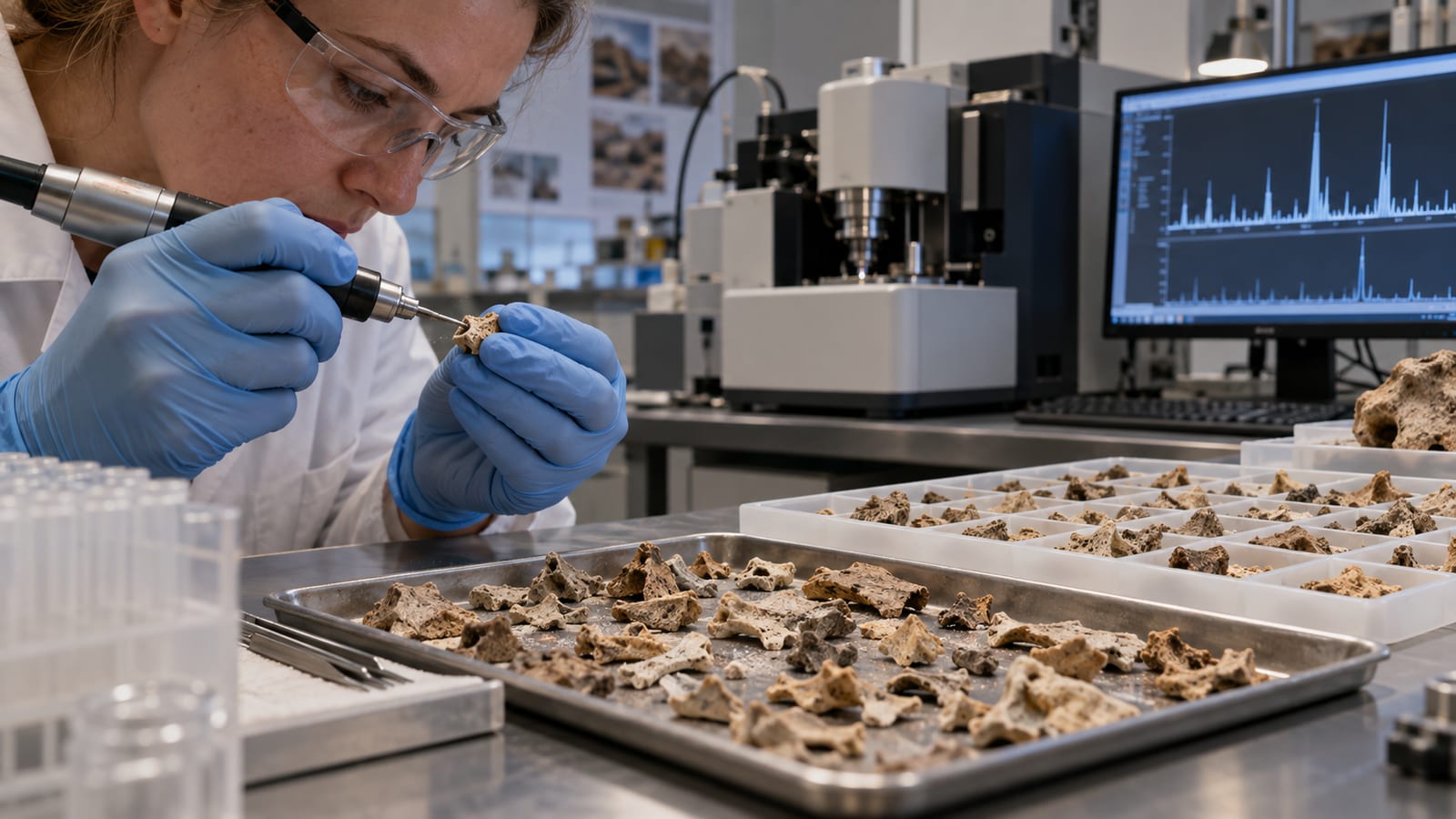
Most of the bones were fragments. According to the protein study, the team morphologically screened more than 60,000 pieces, examining thickness, joint surfaces, muscle attachments and other surviving clues. That effort produced 22 possible hominin fragments. Seventy-six fragments were selected for ZooMS analysis, and 17 samples underwent deeper proteomic sequencing.


ZooMS is short for zooarchaeology by mass spectrometry. The method extracts collagen and measures its component peptides. Because amino-acid sequences vary among animal groups, the resulting pattern can behave like a molecular barcode. It is particularly useful when a bone has lost every feature that would normally identify it.
The molecular work revealed two parietal fragments from the skull and one proximal radius from the forearm. The researchers also analyzed two of the teeth: a lower fourth premolar and a lower second molar.
All five specimens carried the same telling change in collagen, COL1A2 R996K. The variant occurs in the molecularly identified Denisovans used for comparison. The Bianfu specimens produced no confidently identified variants specifically derived in modern humans or Neanderthals. When the researchers used longer protein sequences to construct evolutionary relationships, every specimen grouped with the high-coverage Denisova 3 reference individual with 100 percent posterior probability within their reported Bayesian models.
That percentage describes the outcome of a model, not omniscience. Proteins preserve less ancestry information than a high-quality nuclear genome, and no Bianfu genome has been reported. Researchers therefore cannot yet determine which Denisovan population lived in the cave or whether it was closely related to groups that contributed DNA to people now living in Southeast Asia and Oceania.
The identification nevertheless convinced outside experts. National Geographic reported that evolutionary geneticist Svante Pääbo, who was not involved in the work, regarded the available molecular evidence as limited but said he was quite convinced the remains were Denisovan. Ancient-protein specialist Frido Welker, also not involved, said the new locality could help researchers move beyond understanding Denisovans chiefly through their genetic legacy.
The broader archaeological study attributes seven remains to Denisovans: three bones and four teeth. Proteins directly identified five of them. The other two teeth were assigned through their internal and external morphology.
That distinction matters. So does the fact that Bianfu is now the most fossil-rich identified Denisovan locality outside the Siberian cave that gave the group its name.
The forearm bone that was missing
Denisovan anatomy has been assembled from an extraordinarily odd inventory: teeth, pieces of jaw and skull, a finger bone, a rib and a few other fragments. Before Bianfu, no radius, the forearm bone running along the thumb side of the arm, had been identified as Denisovan.
The Bianfu specimen preserves approximately 45 millimeters from the end that meets the upper arm at the elbow. Its maturity indicates that it came from an adult or near-adult. The reconstructed radial head is large, falling closer in size to the Neanderthal examples than to the modern-human comparison sample.
Its overall form told a different story. A size-independent analysis of external shape aligned the bone more closely with modern humans and the study's Homo cf. erectus specimen, largely because of its relatively short neck. The cross-sectional measurements were less useful for sorting it among groups: one rigidity ratio overlapped all of the comparisons, while other measurements did not reproduce the external-shape result.
It is an anatomical mosaic rather than a tidy label.
Shape can reflect how forces travel through a bone, but one incomplete radius cannot reveal an entire population's strength, occupation or habitual movements. The defensible conclusion is narrower: Denisovan postcranial anatomy may not fit cleanly into either a Neanderthal-shaped or modern-human-shaped category.
The skull pieces add two more data points. They measure 7.6 and 10.0 millimeters thick at their centers, placing them among the robust cranial remains known from several archaic human groups. Variation within and between groups is broad, however. These fragments extend the picture; they do not complete it.

A practical toolkit in a conifer forest
The archaeological study dates the cave's cultural sequence to approximately 190,000-70,000 years ago. Pollen and animal remains indicate a landscape dominated by conifer forest or forest-steppe through changing glacial conditions.
Deer and large bovids dominate the identifiable animal remains. Cut marks and deliberate breakage support the researchers' interpretation that medium- and large-bodied animals were processed for resources including meat, marrow and grease. The authors describe the cave's inhabitants as specialized hunters of this prey, although archaeology reconstructs those actions from material patterns rather than direct observation.
The stone technology was notably expedient. Instead of investing heavily in standardized, extensively shaped tools, the toolmakers often reduced local cores quickly and produced usable edges. The assemblage includes cores, flakes, scrapers, choppers and hammerstones.
Calling such technology “simple” can smuggle in an assumption the evidence does not support. A quickly produced tool is not necessarily a bad tool. If useful weight, edges and surfaces are readily available, extensive reshaping may waste time and material. The researchers interpret Bianfu's strategy as emphasizing what an object could already do, its affordances, over intensive manufacture.
Bones were incorporated into that system. Some appear to have been used with little or no reshaping; others were deliberately modified. Similar uses of bone are known from Neanderthal contexts, but Bianfu suggests that this practical technological approach was not exclusive to Neanderthals.
What remains uncertain is who left each object.
The 120,000-year caveat
Bianfu offers a rare connection between Denisovan bodies and archaeology, but the strength of that connection changes as the timeline expands.
The cultural sequence covers roughly 120,000 years, from approximately 190,000 to 70,000 years ago. The identified Denisovan fossils occupy a narrower interval, approximately 167,000-134,000 years ago. The authors describe the longer sequence as “most parsimoniously attributed” to Denisovans.
In plainer language, Denisovans are the simplest current explanation for the archaeological record, especially where remains and artefacts occur together. Proteins have not, however, identified a Denisovan in every layer. Nor can the evidence demonstrate an unbroken 120,000-year tenancy. Other human groups could conceivably have visited the cave during parts of the sequence.
This is not a technicality that drains the discovery of meaning. It explains why the site is so valuable. At Bianfu, molecular identity, anatomy, tools, prey, habitat and chronology converge in one stratified cave, but they do not all carry the same level of certainty.
Denisovans remain visible in living genomes, yet genes alone cannot show someone selecting a stone, breaking an animal bone or returning to a useful shelter. Bianfu begins to bring those actions into view: not as a cinematic reconstruction, but as a field of broken objects in which five pieces of ancient human retained enough molecular information to identify the people at the center of the story.
Sources / further reading
- Ancient proteins identify various Denisovan remains from Southwest China
- Denisovans from southwestern China and their subsistence strategies
- Bianfu Cave research dataset
- Researchers Discover Rare Denisovan Bones in a Cave in China
- Nature Portfolio press summary
- PubMed record for the proteomics study
- PubMed record for the archaeology study
Keep exploring


