The Denisovan Bones Hiding in a Haystack of 60,000 Fragments
Researchers manually narrowed a vast collection of broken bones to 22 candidates. Ancient proteins revealed three overlooked human fossils, and added a new bone to the barely known Denisovan skeleton.

At Bianfu Cave in southwestern China, the bones had mostly stopped looking like bones.
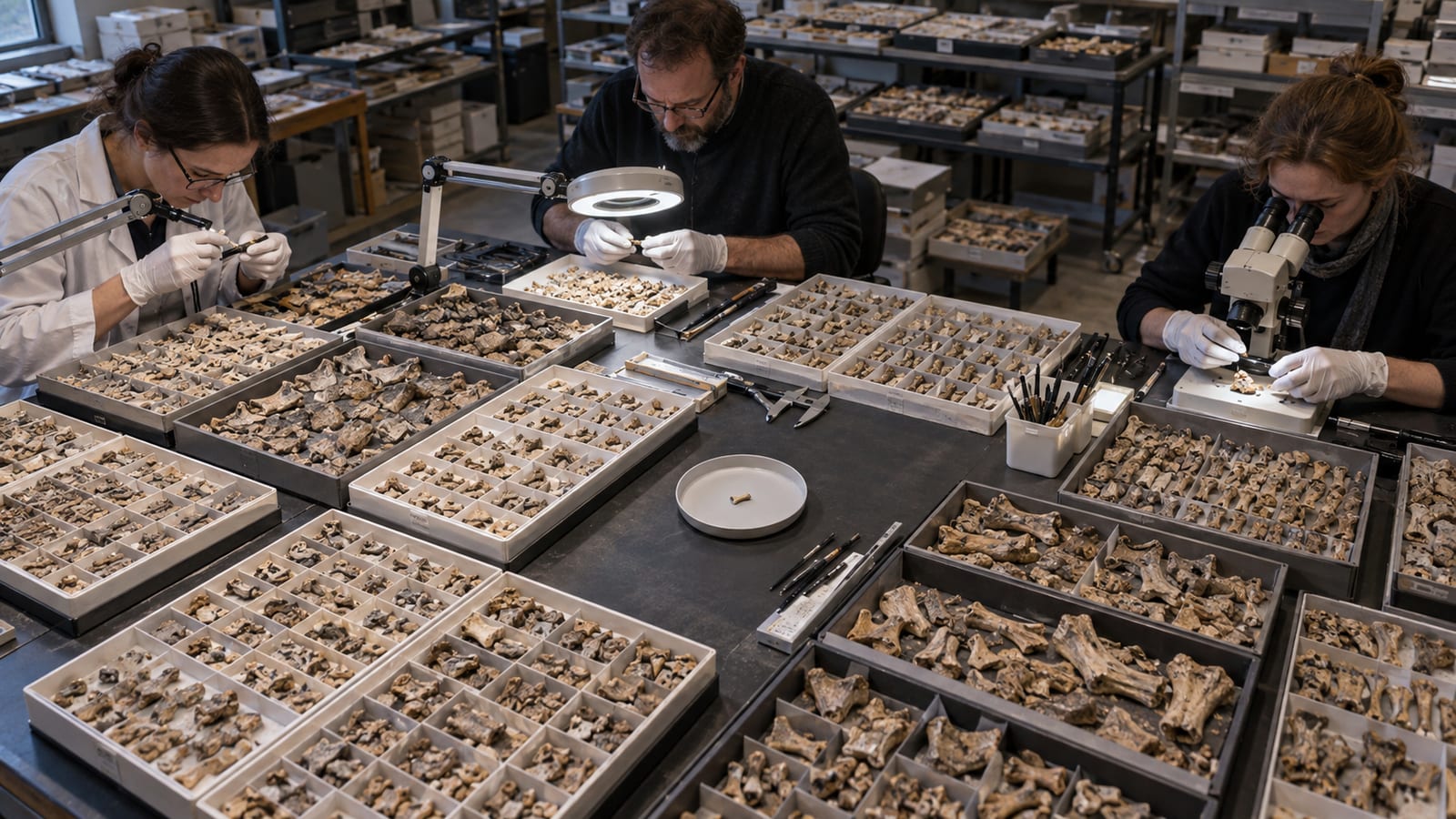
Excavators recovered more than 64,000 mammal fossils from the cave's cultural deposits. More than 60,000 were fragments: broken pieces missing the joints, ridges and other landmarks that normally tell an anatomist whether a bone belonged to a deer, a hyena or a human.
Somewhere in that rubble, however, were pieces of one of humanity's most elusive relatives.
In a study published in Nature, researchers report identifying three previously unrecognized human bones from the fragment collection. Two are pieces of the parietal bones that form the upper sides of the skull. The third is part of a radius, one of the two bones in the forearm, and the first radius ever identified as Denisovan.
Deeper protein analysis assigned all three bones, along with two hominin teeth found during the excavation, to the Denisovan lineage. The result makes Bianfu Cave what the researchers describe as the richest known Denisovan fossil site outside Denisova Cave in Siberia.
It also demonstrates something easy to miss amid the excitement over a new ancient-human discovery: the fossils we need may already have been excavated. They just may not look important yet.
How to search 60,000 broken bones
The team did not feed every fragment into a mass spectrometer. Instead, researchers first narrowed the collection by inspecting more than 60,000 pieces by hand.
They looked at the fragments' size, the thickness of their dense outer bone and surviving surface features such as muscle attachments and blood-vessel impressions. That laborious pass reduced the haystack to 22 possible hominin fragments.
The team then used a technique called ZooMS, short for zooarchaeology by mass spectrometry. It works with collagen, the main protein in bone and a molecule that can survive after usable DNA has disappeared.
Researchers extract the collagen and cut it into smaller molecules called peptides. A mass spectrometer measures those peptides, producing a pattern that can be compared with reference animals. Because collagen sequences vary among branches of the animal family tree, the pattern functions as a taxonomic fingerprint, although its resolution varies, and it does not always identify a species by itself.
In total, the researchers ran ZooMS on 76 fragments. That group included the 22 possible hominin bones and 54 randomly selected pieces used to check how well collagen had survived in different cave layers.
Three of the 22 candidates produced collagen signatures belonging to the human genus Homo. The other identifiable candidates included bovids, deer and hyenas.


Finding a human fragment was only the first step. ZooMS could not, on its own, reveal what kind of human it had found.
The protein trail to Denisovans
Denisovans are an unusually appropriate target for this sort of molecular detective work. Scientists discovered the population in 2010 not from a distinctive skull or skeleton, but from DNA recovered from a tiny finger bone excavated in Denisova Cave.
That genetic evidence established a population closely related to Neanderthals. It also showed that Denisovans interbred with ancestors of living people, leaving genetic ancestry that persists in populations across parts of Asia and Oceania.
For years, though, the Denisovans had almost no recognizable body. Researchers knew their genome better than their skeleton.
The Bianfu team attempted to recover ancient DNA from the three newly recognized human bones but failed. It therefore went deeper into the surviving proteins, using liquid chromatography and tandem mass spectrometry to recover and sequence more peptides. Researchers conducted comparable analyses on two teeth that excavators had already identified as hominin.
All five fossils carried the same informative change in a collagen protein: a variant called COL1A2 R996K. In the comparative evidence used by the researchers, that variant appears consistently in molecularly identified Denisovans, including fossils from Siberia, the Tibetan Plateau, northeastern China and the Taiwan Strait.
The team reported no confidently identified protein variants derived specifically from Neanderthals or modern humans. It also constructed evolutionary trees from the recovered protein sequences. In those analyses, every Bianfu specimen grouped with Denisova 3, the Siberian individual whose high-quality genome has become a central Denisovan reference, with a reported posterior probability of 100 percent.
That is strong palaeoproteomic evidence, but it is not the same as sequencing a Bianfu genome. Proteins contain far less hereditary information than DNA, and some amino-acid variants are shared among different human groups. María Martinón-Torres, a paleoanthropologist not involved in the research, warned in an interview with EL PAÍS against treating a single protein mutation as an infallible species barcode.
The assignment did not rest solely on that collagen variant. The authors also evaluated other informative amino-acid substitutions and constructed phylogenetic trees from the recovered protein sequences. Those are complementary forms of palaeoproteomic evidence rather than wholly independent identification methods. The fossils' anatomy and archaeological setting add useful context, but neither independently establishes their population identity.
Until DNA is recovered or independent work extends the results, the careful description is that the five fossils have been assigned to Denisovans through ancient-protein evidence.
A missing piece of the Denisovan map
The fossil-bearing layers at Bianfu Cave are dated to approximately 167,000-134,000 years ago. Those ranges come mainly from a model combining luminescence dates from sediments with uranium-series dates from cave formations.
Direct uranium-series measurements on the bones produced younger minimum ages for some specimens. The researchers explain that buried bone can gain or lose uranium, making it an open system and complicating direct dating. They therefore considered the surrounding layer chronology more reliable.

The location matters as much as the age. Bianfu Cave lies in western Yunnan, near a geographic crossroads connecting the Tibetan Plateau with East, South and Southeast Asia. Before this discovery, molecularly identified Denisovan fossils had been found in Siberia, on the Tibetan Plateau, in northeastern China and near Taiwan, but not in southwestern China.
That absence always looked suspicious. Genetic studies indicate that multiple Denisovan populations contributed ancestry to living people in Asia and Oceania. A Denisovan presence in Yunnan does not reveal exactly when or where those encounters with modern humans happened, but it puts fossils in a region that makes the broader genetic geography easier to understand.
What one forearm fragment can, and cannot, tell us
The radius fragment preserves only about 45 millimetres from the end nearest the elbow. Its fused growth plate and dense outer structure suggest an adult or near-adult individual.
Even that small piece carries a curious mixture of anatomy. Its large radial head and probably inward-facing radial tuberosity resemble features commonly seen in Neanderthals. Its overall external shape and the geometry of its neck aligned more closely with the modern-human specimens in the study.
The radial tuberosity anchors the biceps, while the head and neck help transfer forces through the elbow and forearm. That makes the bone relevant to questions about mechanical loading and arm use. But a single reconstructed fragment cannot tell us how Denisovans moved, what work they performed or how strong they were. The comparative fossil sample was also necessarily small.
Its real importance is more basic. Until now, known Denisovan remains from below the skull included a finger phalanx and a rib fragment. The radius adds a new part to a skeleton that scientists are still assembling one piece at a time.
A companion Nature study supplies context for those bodies. Bianfu Cave contained 1,366 stone artefacts, abundant animal remains and evidence of a conifer-dominated forest or forest-steppe. The researchers infer that its inhabitants focused on medium- and large-bodied prey and relied on relatively expedient stone and bone technologies.
The cave's entire cultural sequence spans roughly 190,000-70,000 years, but that does not mean one Denisovan population lived there continuously for 120,000 years. Nor do fossils from a few layers prove who made every object in the sequence. The companion paper describes Denisovan authorship across the record as the most parsimonious interpretation, a useful distinction between the best current explanation and direct proof.
What Bianfu establishes most clearly is that anonymous fragments can carry extraordinary amounts of information. A piece of bone does not need a recognizable shape, much less an intact genome, to re-enter the human story.
There are vast collections of similarly unidentifiable fragments in museums and archaeological repositories. After Bianfu, some of them look less like debris and more like an unread library.
Sources / further reading
Keep exploring


