The Cave That Turned Denisovans From DNA Into Hunters
Ancient proteins identified Denisovan fossils beside tools and butchered animal bones in southwestern China. The result is a rare portrait of an extinct human lineage, and a lesson in why simple-looking technology is not necessarily simplistic.

For most of their scientific existence, Denisovans have been less like people than a signal.
They first emerged from DNA extracted from a tiny finger bone found in a Siberian cave. Later, their genetic fingerprints appeared in living populations across Asia and Oceania. A jaw surfaced here, a tooth there, a rib somewhere else. Researchers could trace Denisovans across a continent without being able to say much about what they did on an ordinary day.
Bianfu Cave changes that.
Inside the badly damaged cave in China’s Yunnan Province, archaeologists found Denisovan teeth and bones in the same layered deposits as stone tools, animal remains and ancient pollen. Two studies published in Nature on September 9, 2026, turn that combination into one of the clearest pictures yet of a Denisovan community: people who repeatedly hunted deer and large bovids, broke open bones for their contents and often made only as much tool as the job demanded.
That last detail may be the most revealing. Their tools were not elaborate. They were practical.
Five fossils identified by protein
The discovery nearly did not survive the modern world.
Bianfu Cave sits in a former limestone quarry. Its roof, entrance and front had already been severely damaged when an ecological-restoration project led to a rescue excavation in 2019. Archaeologists worked roughly 30 meters from the cave’s original entrance and recovered four hominin teeth, two pieces of parietal bone from the skull and part of a radius, the forearm bone on the thumb side.
Those seven remains were mixed into an assemblage containing more than 64,000 mammal-bone fragments. A fragment of human skull can be surprisingly difficult to distinguish from the broken remains of other large mammals, so the researchers began with a visual screening. They selected 22 possible hominin fragments from more than 60,000 bones and tested their collagen using zooarchaeology by mass spectrometry, or ZooMS.
ZooMS is a biological sorting system for bones that have lost their recognizable shape. Collagen molecules vary slightly among branches of the animal family tree. Mass spectrometry can detect those patterns and narrow an anonymous shard down to a taxonomic group.
Three fragments produced collagen associated with the genus Homo: the two skull pieces and the radius. Attempts to recover ancient DNA from them failed, but DNA is not the only molecular record a fossil can preserve. Proteins are often tougher.
In a companion Nature paper, researchers sequenced proteins from those three bones and two of the teeth. All five contained an amino-acid variant in a collagen protein that has appeared consistently in other molecularly identified Denisovans. Protein-based family trees also placed all five with the well-studied Denisova 3 individual from Siberia.
The other two teeth were evaluated through their anatomy and archaeological context rather than the same full molecular assignment. That distinction matters: Bianfu produced seven hominin fossils, but the companion study’s detailed proteomic identification covers five of them.

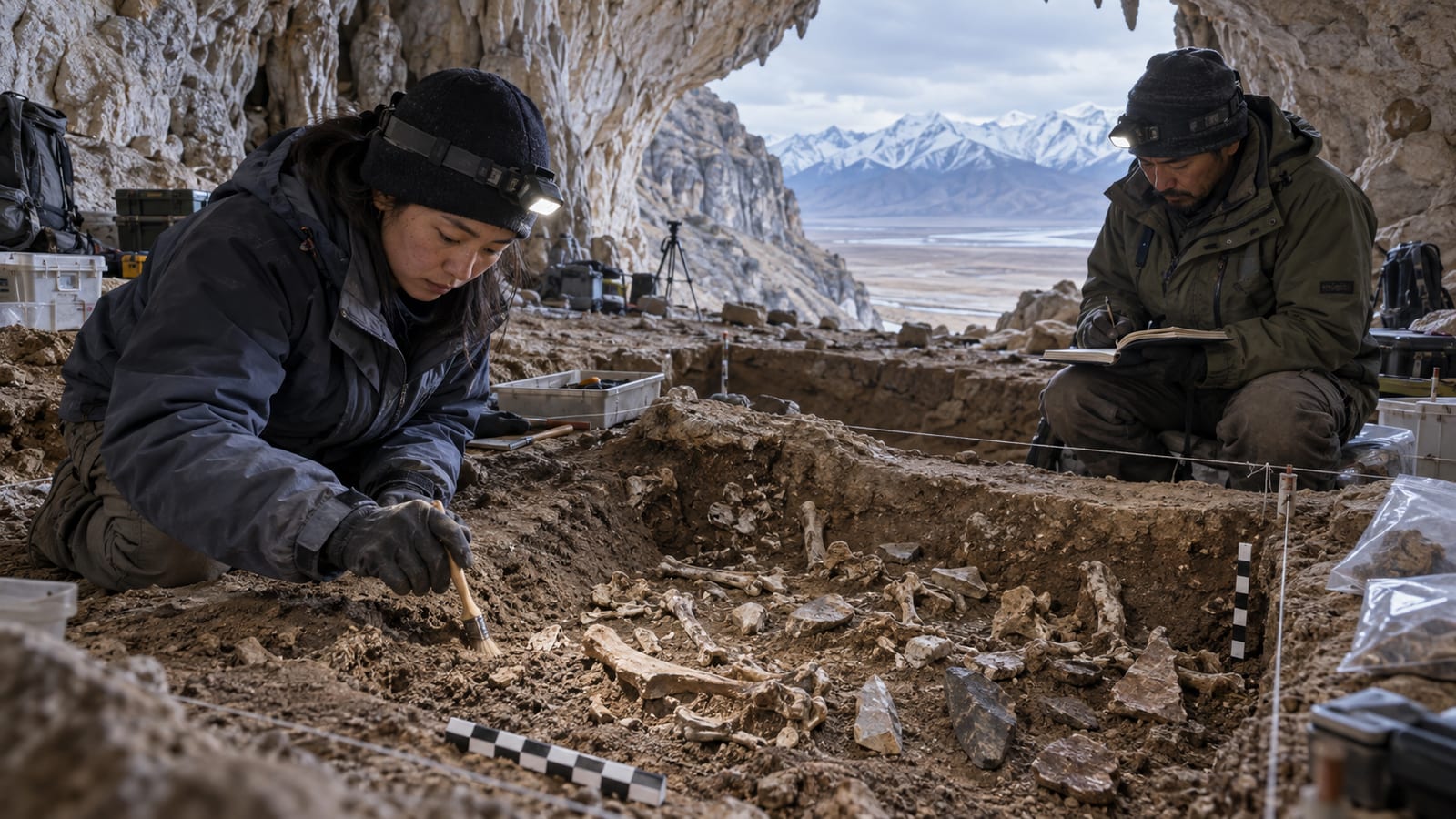
Even so, the find makes Bianfu one of the richest known Denisovan fossil localities, second only to Denisova Cave itself.
A useful edge was enough
The fossils occur in layers dated to roughly 167,000-134,000 years ago. Human activity at the cave covers a much larger window, from approximately 190,000 to 70,000 years ago.
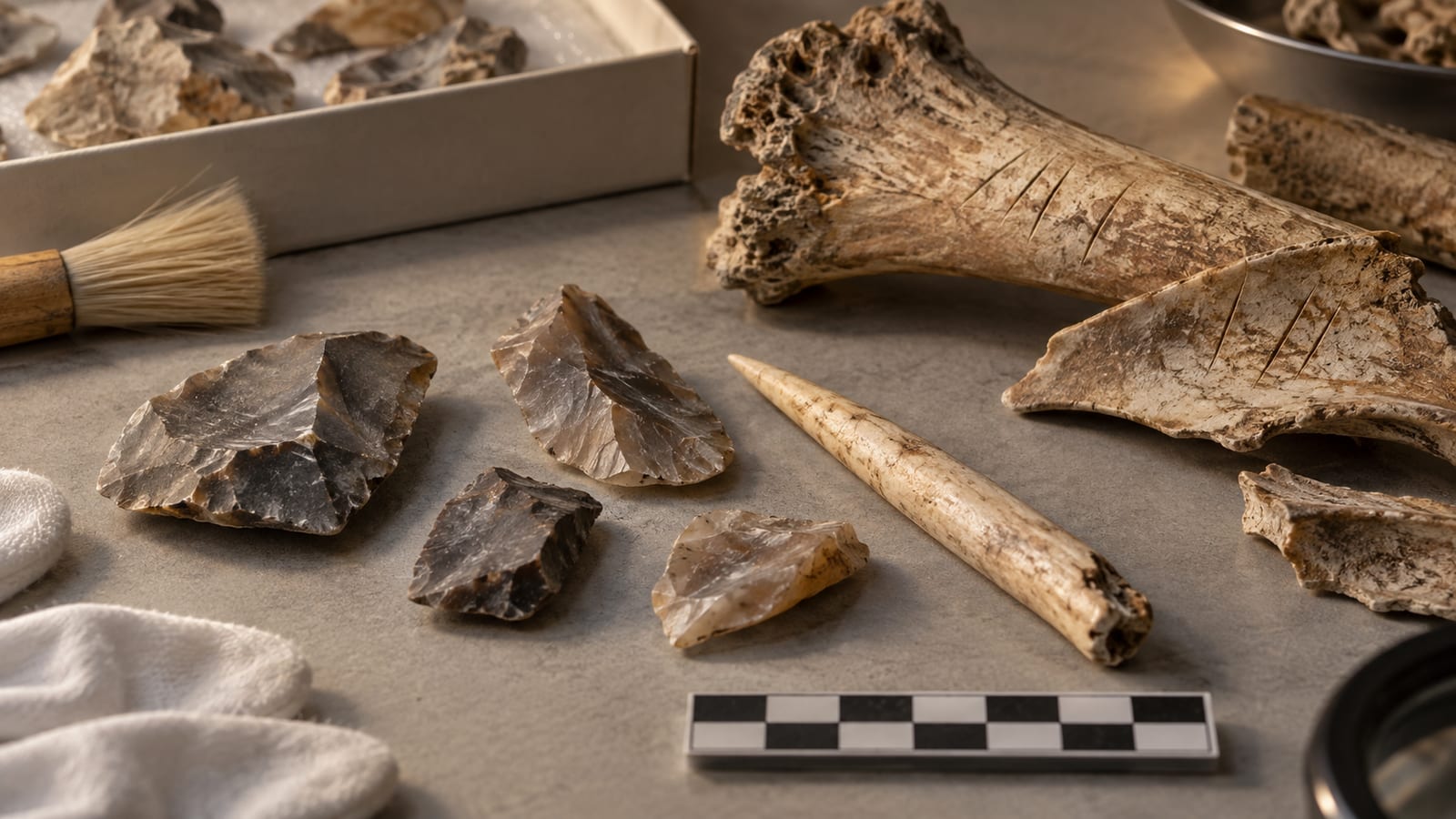
Across that sequence, excavators documented 1,366 stone artifacts. The inventory includes cores from which flakes were struck, scrapers, choppers, notched and toothed tools, points and hammerstones. But much of the stone was worked only lightly. Instead of investing in a standardized shape, the toolmakers often appear to have struck a useful edge, performed a task and moved on.
They treated bones in a similar fashion. Some became recognizable bone tools, while others seem to have been used with little or no reshaping. The researchers describe this as exploiting an object’s “affordance”, in plain language, noticing what a thing can already do.
A sharp flake can cut whether or not someone spends another hour refining it. A dense fragment of bone can strike, scrape or press without being transformed into an elegant implement. If locally available material works, extra craftsmanship may produce no practical return.
That makes “simple” a dangerous word here. A minimally shaped tool might reveal limited skill. It might also reveal that its maker understood exactly how little work was necessary.
The same technological logic appears through much of the cave’s long sequence. It was not a march toward ever more complicated objects. It was a durable strategy built around useful edges, convenient shapes and low manufacturing cost.
What was on the menu
The tens of thousands of animal remains supply another part of the picture. Deer and bovids dominate the identifiable assemblage, including animals such as water buffalo and gaur. Cut marks and deliberate fracture patterns indicate that carcasses were processed at the site for meat, marrow and grease.
The distribution of species, body sizes and ages led the researchers to infer specialized hunting of medium- and large-bodied prey. In other words, the cave’s bones do not look like a random sample of everything that died nearby. The occupants appear to have concentrated on animals that offered substantial returns.
Pollen reconstructs the setting around them: a conifer-dominated forest or forest-steppe that persisted through major glacial stages. Southwestern China was not free of climatic change, but the researchers argue that this environment offered a comparatively stable supply of large herbivores.
The combination makes the expedient toolkit easier to understand. These were hunters processing large animals in a resource-rich landscape, not artisans competing to make the most symmetrical object. Their technology had to cut hide, separate joints, remove meat and open bones. It did not have to impress an archaeologist 150,000 years later.
Bianfu should not be mistaken for the universal Denisovan lifestyle. At Baishiya Karst Cave on the Tibetan Plateau, another Denisovan subsistence study found exploitation of a much wider range of animals in a high-altitude environment. Denisovans occupied an enormous and ecologically varied part of Asia. Expecting every population to share one toolkit would be like expecting every modern human society to cook the same meal.

The first Denisovan forearm
Bianfu also supplied a body part no one had previously identified for this lineage: about 45 millimeters from the elbow end of a radius.
The individual was probably an adult or near-adult. The fragment has a large joint surface and a probable orientation of the biceps attachment that resemble Neanderthals. Yet its overall shape and the geometry of its neck align more closely with modern humans in the researchers’ comparisons.
That mosaic could reflect different mechanical demands on the arm, but it cannot reconstruct a Denisovan physique by itself. One incomplete bone represents one individual, and the relevant protein evidence is still too sparse to show how the Bianfu population related to other Denisovan groups. The scientists recovered no usable ancient DNA from the three bone fragments.
What the radius does provide is a real anatomical anchor. Denisovans are no longer represented below the skull only by a finger bone and a rib. Researchers can now compare part of an elbow and forearm directly with Neanderthals, modern humans and other hominins.
A 120,000-year record, with an asterisk
There is one final boundary the evidence cannot cross.
The Denisovan fossils securely demonstrate their presence in Bianfu’s layers between about 167,000 and 134,000 years ago. The complete cultural sequence extends for roughly 120,000 years, and the research team considers Denisovans the most economical explanation for it.
That does not prove that Denisovans made every artifact from the oldest layer to the youngest. Nor does it mean one population lived in the cave continuously for 120,000 years. The deposits could represent repeated visits separated by long intervals, and another human group could eventually turn up in part of the sequence.
The cave’s importance survives that caveat. At most Denisovan sites, researchers have had a fossil without much behavior, behavior without a securely identified maker, or genetic evidence without a body. Bianfu brings those lines of evidence together in the same layered place.
The result is not a complete biography of the Denisovans. It is something more defensible and, in its own way, more human: a picture of one population solving the problems immediately in front of it.
Find an animal worth the effort. Carry it back. Use the edge that cuts. Use the bone that already fits the hand. Make more only when more is needed.
Sources / further reading
- Ruan et al., Denisovans from southwestern China and their subsistence strategies
- Rao et al., Ancient proteins identify various Denisovan remains from Southwest China
- Ruan et al., 2019 excavation report of the Bianfudong Paleolithic site
- Reich et al., Genetic history of an archaic hominin group from Denisova Cave in Siberia
- Xia et al., Middle and Late Pleistocene Denisovan subsistence at Baishiya Karst Cave
- University of Wollongong research release
- ABC News independent report
Keep exploring


