Who’s Actually Closest to Putting Humans on Mars?
The strongest contender is a partnership. The biggest uncertainties involve landing, keeping people alive, and getting them home.

The mass of NASA’s Perseverance rover is about 1,025 kilograms. Delivering it safely to Mars required a heat shield, a parachute, rocket engines, and a flying crane that lowered the rover onto the ground. It was an extraordinary landing. It was also a delivery of roughly one metric ton. NASA’s mission account
For human exploration, NASA has studied landers delivering payloads of 20-30 metric tons apiece. That range depends on the mission design, but it captures the size of the problem: sending people means landing substantially heavier equipment than the machines already exploring Mars. NASA’s human-scale entry research
That gap is a useful place to begin judging the race.
Based on publicly documented capabilities through September 13, 2026, NASA, SpaceX, and their commercial and international partners collectively have the strongest foundation for a human Mars expedition. SpaceX has the leading actively flight-tested transport development effort explicitly intended to carry people to Mars. NASA and its partners contribute a much broader record of human spaceflight, life-support research, and operations at the destination.
China is the strongest independent national challenger in this comparison. It has its own inhabited space station, has landed a rover on Mars, and is developing hardware for crewed lunar exploration.
Those are judgments about demonstrated progress. None establishes a reliable year for the first human landing. Nobody has yet demonstrated the complete combination of heavy Mars landing, independent crew survival, surface operations, ascent, and safe return.
SpaceX’s advantage is real. So is the unfinished work.
SpaceX brings something unusually valuable to an expedition that may require assembling and supplying spacecraft in orbit: experience operating rockets repeatedly. Its June 2026 prospectus reports 165 Falcon launches in 2025. That is substantial manufacturing and launch experience, although it belongs to the Falcon fleet. Starship still has to establish its own reliable operating rhythm. SpaceX’s prospectus
Starship has made visible progress. Its July 24 Flight 13 completed a suborbital flight and a controlled upper-stage splashdown in the Indian Ocean. Those events provide useful evidence about flying and returning the vehicle through Earth’s atmosphere. They do not demonstrate a Mars journey or an operational orbital transport service. Contemporary flight coverage
One essential next capability is refueling in space.
Starship’s beyond-Earth-orbit architecture depends on transferring extremely cold propellant between spacecraft. That requires vehicles to meet, dock, move the liquids successfully, and preserve enough propellant for the mission. A sequence of launches must deliver those vehicles and their supplies reliably.
SpaceX has already demonstrated moving liquid oxygen between tanks inside a single Starship. Refueling from another spacecraft is a separate milestone. NASA’s technical account distinguishes the completed internal transfer from the subsequent large-scale demonstration. NASA’s HLS technical paper
In its July 2026 assessment, the Government Accountability Office identified cryogenic propellant management as a major Starship lunar-lander risk, with important demonstrations delayed. We found no public evidence establishing a completed operational ship-to-ship refueling campaign by this article’s cutoff. GAO’s assessment
SpaceX’s Mars service page advertises cargo flights beginning no earlier than 2028. That is a company target for cargo. It is neither a demonstrated delivery capability nor a commitment to launch people that year. SpaceX’s Mars offer
The reason to take SpaceX seriously is the hardware development behind its ambition. The remaining question is whether it can turn individual tests into a dependable expedition system.
NASA supplies experience that a rocket cannot
NASA’s SLS rocket and Orion spacecraft have now flown an uncrewed lunar mission, Artemis I in 2022, and the crewed Artemis II flyby in April 2026. The latter demonstrated a modern American-led system taking astronauts around the Moon and returning them to Earth. Europe supplied Orion’s service module, illustrating how much of this capability already belongs to a partnership. Artemis I, Artemis II, ESA’s mission account
Two SLS launches across those years establish flight experience, but not a frequent heavy-lift service. And a lunar flyby does not qualify a spacecraft to house a crew for a Mars expedition.


For that, the less spectacular machinery matters enormously.
In 2023, NASA announced that the relevant International Space Station water-recovery configuration had reached 98% recovery. The system recovers water from sources including cabin humidity and processed urine. Recovering more water reduces the amount a crew must carry or receive from Earth. NASA’s water-recovery report
But that percentage describes water recovery. It does not mean a spacecraft recycles 98% of everything its occupants need. Food, replacement parts, maintenance, medical care, and failures remain part of the problem.
NASA’s human-research program also studies radiation, isolation, changing gravity, and the hazards of living inside a closed environment. Station experience helps, but a Mars crew would operate far beyond the regular logistics and comparatively accessible return routes of Earth orbit. NASA’s human-spaceflight hazards
This explains why a simple NASA-versus-SpaceX contest is misleading. NASA is paying SpaceX to develop a lunar lander while providing expertise relevant to technologies SpaceX also needs for Mars. Blue Origin is developing another lunar lander. These companies compete within an effort that also pools capabilities.
The current Artemis sequence reflects how much testing remains: NASA targets an Earth-orbit demonstration involving Orion and commercial lander hardware for Artemis III in 2027, followed by an Artemis IV lunar landing in 2028. These remain objectives. Older accounts describing Artemis III as the landing mission are out of date. NASA’s revised architecture
China has demonstrated more than a distant ambition
China’s most persuasive evidence is already in space.
Tiangong provides experience with long-duration habitation, regenerative life support, docking, and orbital replenishment. Tianwen-1 delivered Zhurong to Mars in May 2021; NASA’s own orbital images subsequently documented the rover on the surface. Chang’e-6 returned lunar samples to Earth in 2024. Together, these achievements show capabilities spanning human operations, interplanetary navigation, landing, and robotic return missions. CMSA’s station review, NASA’s Zhurong imagery, Chang’e-6’s mission account
China is also testing its next generation of crew-transport hardware. On February 11, 2026, it conducted a Long March 10 low-altitude demonstration and a Mengzhou spacecraft abort test. That is meaningful progress toward its crewed-lunar program. The test did not send a spacecraft into lunar orbit, and the larger Long March 9 heavy-lift system remains a development effort in the reviewed public record. CMSA’s test report, the heavy-lift roadmap
The widely repeated claim that China will send people to Mars in 2033 requires more care.
A June 2021 account published by China Space News described Wang Xiaojun’s proposed transportation architecture. It listed departure years including 2033 and discussed systems such as nuclear propulsion and orbital assembly. The document presented a concept; it did not establish that a complete expedition had received funding and an approved launch schedule. The contemporaneous institutional account
The more concrete Mars project to watch is Tianwen-3. CNSA’s April 2026 announcement targets launch around 2028 and return of Mars samples around 2031. Successful departure from the Martian surface would demonstrate a capability especially relevant to getting anything, including eventually people, home. It would still be a robotic mission. CNSA’s announcement
China therefore deserves serious weight in this comparison. Public evidence does not establish that it has solved the heavier landing, autonomous habitation, or return requirements of a human expedition.
The capabilities that could decide the outcome
The leading efforts have different strengths, but their biggest unfinished tasks overlap.
| Requirement | Demonstrated progress | Remaining leap |
|---|---|---|
| Heavy transport | Operational launchers and Starship flight tests | Reliable delivery of an expedition’s full mass and supplies |
| Orbital refueling | Station replenishment; internal Starship cryogenic transfer | Repeated large-scale cryogenic transfer and storage between spacecraft |
| Crew survival | Long station stays, recycling systems, crewed lunar flight | Integrated systems that sustain an independent Mars expedition |
| Mars landing | Successful robotic landings | Much heavier payloads delivered safely and repeatedly |
| Surface infrastructure | Robotic operations, oxygen production experiment, reactor ground testing | Dependable crew-scale power, supplies, maintenance, and return capability |
Mars landing is particularly unforgiving. The planet has an atmosphere that must be accounted for during entry, but it is thin enough to make decelerating heavy vehicles difficult. NASA studies investigate rocket-powered deceleration for human-scale landers. A successful landing on the airless Moon cannot validate that entire process. NASA’s entry research
Then comes the return journey.

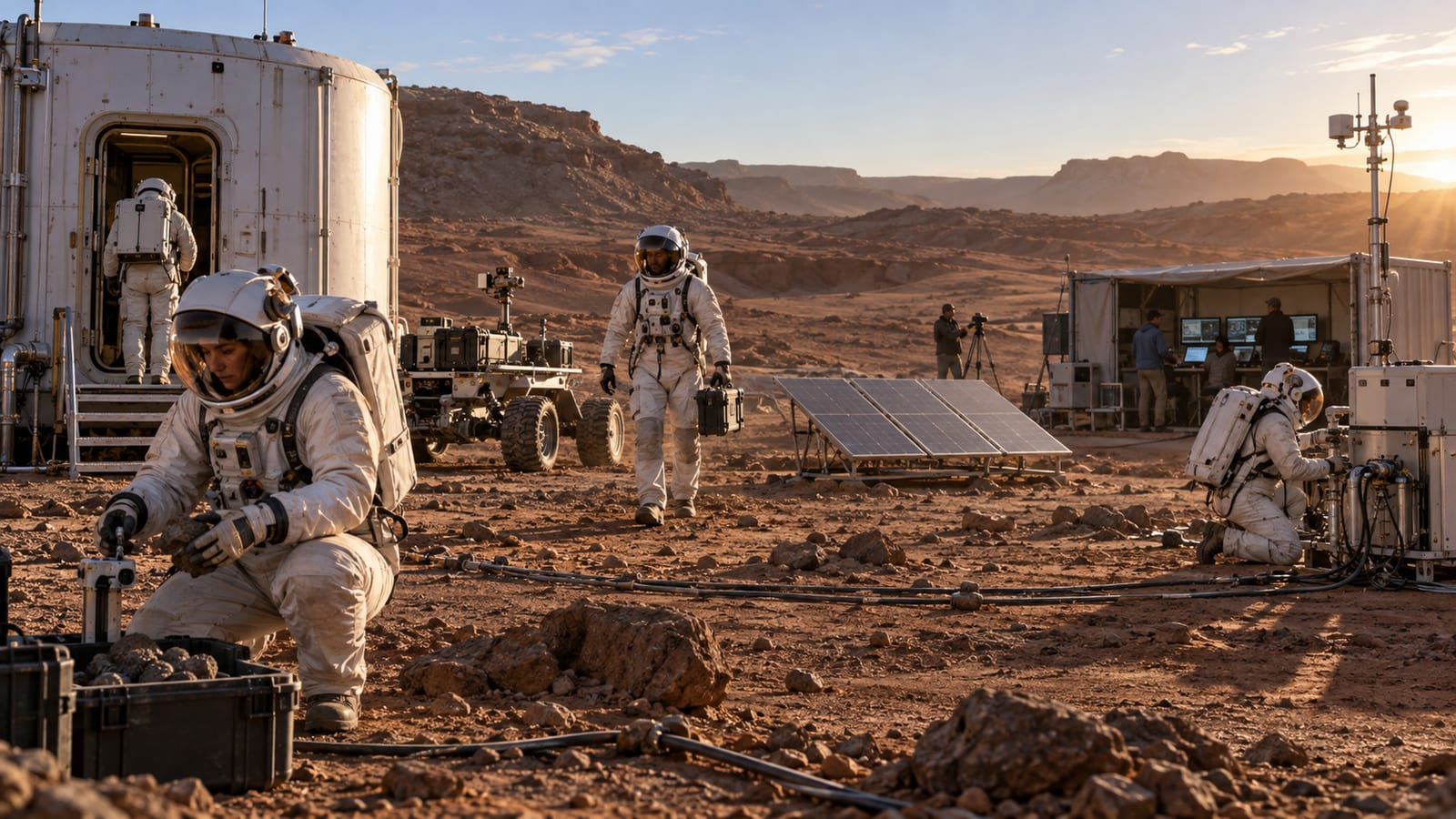
A published Starship-based mission study describes using Martian water and atmospheric carbon dioxide to produce methane and oxygen. Implementing that approach requires finding usable resources, extracting and processing them, and storing the products. The study supplies an engineering concept; it does not document an operating Martian factory. Heldmann and colleagues’ architecture
NASA has tested one relevant piece at Mars. MOXIE, aboard Perseverance, produced 122 grams of oxygen over 16 operations, reaching 12 grams per hour. That is valuable evidence that oxygen can be extracted from the atmosphere under Martian conditions. MOXIE did not make methane or demonstrate an integrated return-propellant plant. The experiment’s completion report
All of this needs reliable power. NASA selected fission as its baseline primary power source for initial human Mars surface missions. Its KRUSTY project completed a nuclear ground test in 2018, providing real experimental experience. A reactor powering a crew on Mars remains a future achievement. NASA’s power decision, KRUSTY test results
NASA’s proposed Space Reactor-1 Freedom mission, targeting late 2028, would demonstrate nuclear-electric propulsion on an interplanetary mission. It is relevant development, but its planned performance cannot yet be added to the list of completed capabilities. NASA’s mission description
Communications presents a different distinction. NASA and ESA already have Mars relay experience. On September 1, NASA awarded Blue Origin a contract with a maximum potential value of approximately $700 million for new Mars communications infrastructure, expected to operate at the planet by 2030. An award is stronger evidence than an unaffiliated proposal; the resulting network still has to be built and delivered. The existing relay network, NASA’s contract announcement
Even excellent equipment cannot remove the signal delay. Earth-Mars communications can take about 22 minutes one way, depending on the planets’ positions. A crew facing an urgent failure needs the ability to act locally. NASA’s communications analysis
Money and partners change the picture
Substantial money is being spent, but there is no honest single-column budget league table.
SpaceX disclosed approximately $3.0 billion of Space-segment research and development spending for 2025, mainly associated with Starship. That covers a vehicle intended for multiple markets and destinations. NASA’s inspector general reported $6.9 billion in cumulative obligations for the lunar Human Landing System program. NASA’s FY2027 request separately includes $438.8 million for Mars Technology, a proposed appropriation, not a completed expedition budget. SpaceX’s disclosure, NASA OIG’s audit, NASA’s budget request
Those figures establish serious investment. They do not establish which organization has paid for every step between Earth and a crew’s return from Mars. A comparable public Chinese human-Mars budget was not established in this review.
Other organizations matter through specific contributions. Blue Origin has orbital-launch experience, but its May 2026 New Glenn ground-test accident also shows why launch infrastructure and recovery from failures belong in any assessment of readiness. NASA’s June agreement with Relativity Space assigns it future spacecraft and transportation responsibilities for the Aeolus Mars science payload. Neither contribution makes its provider a complete human-Mars expedition operator. Blue Origin’s recovery account, NASA’s Aeolus announcement
Japan’s MMX mission targets robotic exploration and sample return from the Martian moons. India and the UAE have demonstrated Mars-orbit missions. Russia retains relevant human-spaceflight experience through Soyuz and station operations. These are meaningful capabilities; this review did not establish a complete, comparably advanced human-Mars campaign from those participants. JAXA, ISRO, the UAE mission account, NASA’s station record
The next developments worth watching are therefore quite specific: sustained orbital operations and refueling, heavy cargo landed on Mars, long-duration integrated crew-system tests, reliable surface power, and departure from the Martian surface.
Favorable Mars launch opportunities recur approximately every 26 months. Missing one can move a conventional mission to a substantially later opportunity, which makes promised years a poor substitute for evidence that the necessary systems work. NASA’s explanation of launch opportunities
For now, the American partnership has the broadest demonstrated foundation, and China has enough independent accomplishments to make the contest consequential. The milestone that would most change this assessment is a rehearsal showing that the equipment waiting on Mars can support the people who follow, and provide their way home.
Sources / further reading
- NASA: Perseverance first-year report
- NASA: Human-scale Mars entry research
- SpaceX: June 2026 European prospectus
- Space.com: Flight 13 contemporaneous coverage
- NASA: HLS technical paper
- GAO: NASA major-project assessment
- SpaceX: Mars & Beyond
- NASA: Artemis I launch
- NASA: Artemis II
- ESA: Artemis II splashdown
- NASA: ISS water recovery
- NASA: Human-spaceflight hazards
- NASA: Revised Artemis architecture
- CMSA: Tiangong technical review
- NASA: Zhurong orbital imagery
- CAS: Chang'e-6 mission account
- CMSA: Long March 10/Mengzhou test
- CNSA: Heavy-lift development roadmap
- China Space News: Human-Mars architecture proposal
- CNSA: Tianwen-3 announcement
- Heldmann et al.: Starship Mars architecture
- NASA/JPL: MOXIE completion report
- NASA: Mars surface-power decision
- NASA: KRUSTY ground test
- NASA: Space Reactor-1 Freedom
- NASA: Mars Relay Network
- NASA: Blue Origin Mars communications award
- NASA: Mars communication delay
- NASA OIG: HLS contracts audit
- NASA: FY2027 budget request
- Blue Origin: New Glenn recovery
- NASA: Relativity/Aeolus partnership
- JAXA: MMX
- ISRO: Mars Orbiter Mission
- Dubai Media Office: Hope mission
- NASA: ISS operational record
- NASA: Mars launch opportunities
Keep exploring


