This Tiny Cooler Uses One Metal Film to Make Another Go Cold
One shape-memory film contracts when heated and pulls on a second film that pumps heat. The laboratory result is real, and far smaller and less electricity-free than some headlines suggest.

A metal strip gets hot and contracts. That contraction stretches a second metal strip. Release the second strip at the right moment, and it gets cold.
That is the wonderfully strange chain of events inside a new experimental cooler built by researchers at Karlsruhe Institute of Technology in Germany and the University of Tsukuba in Japan. Instead of using an electric motor to squeeze or stretch its solid refrigerant, their prototype uses another piece of shape-memory metal as a heat-powered actuator.
The result, published in Nature Energy, is not a heat-powered refrigerator ready for your kitchen, or even for a computer chip. With an external heat source, the device moved only a few milliwatts of heat and created a 2.2-degree temperature difference between its hot and cold sides.
But it did something worth paying attention to: it experimentally showed that heat can provide the mechanical drive for a solid-state elastocaloric cooling cycle.
The two films have different jobs
The machine contains two ultrathin metal films mounted in separate, thermally isolated sections but joined by a polymer connector.
The first is a 22-micrometer-thick film of titanium-nickel alloy. It is the actuator, the part that creates movement. When heated past its transformation temperature, its crystal structure changes and the pre-stretched film tries to recover its programmed length. In practical terms, it contracts and pulls.
That pull is transferred to a 26.5-micrometer film made from titanium, nickel and a small amount of iron. This second film is the refrigerant.
Calling a piece of metal a refrigerant sounds odd, but refrigeration is ultimately about moving heat, not about using a particular liquid or gas. Shape-memory alloys can absorb and release heat as mechanical stress forces them between different crystal structures. The phenomenon is called the elastocaloric effect.
The prototype performs the process in four steps.
First, heat makes the actuator contract, stretching the refrigerant film. The stress drives a phase change in the refrigerant and causes it to heat up. The hot film is then pressed against a heat sink so it can dump that heat.

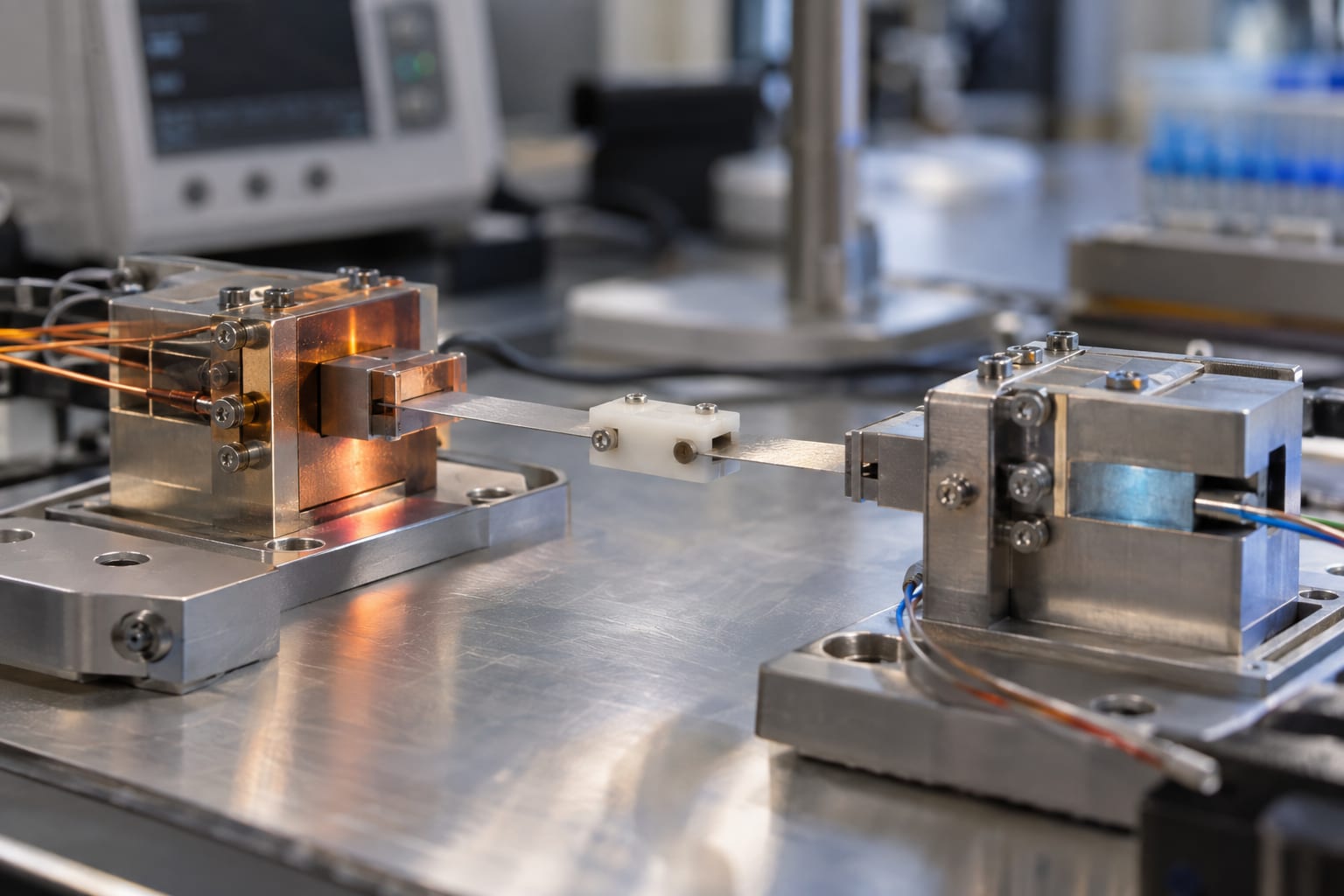
Next, the actuator is cooled. Its pull weakens, the refrigerant film relaxes, and the phase change reverses. That reversal absorbs heat and makes the film colder than its surroundings. The cold film is brought into contact with the object or surface serving as the cooling target, drawing heat away from it.
Repeat the sequence, and heat moves from the cold side of the device to the hot side.
The researchers chose thin films partly because they can exchange heat quickly. Their small mass is also why the prototype can post a cooling-power figure of several watts per gram while producing only milliwatts in total. The active refrigerant weighs almost nothing.
What the experiment actually measured
The team first ran the coupled system by passing current through the actuator film. This Joule heating brought the actuator to an average peak temperature of 86 °C.
Under those conditions, the refrigerant film showed a material-level temperature change of 12.9 K. Once heat exchangers and the rest of the device were included, the sustained temperature span was 4.0 K: the hot side rose by an average of 2.2 K while the cold side fell by 1.8 K.
Those are two different measurements. The 12.9 K figure describes the response of the refrigerant film; it is not a 12.9-degree gap across a working cooler.
The more important test replaced internal electrical heating of the actuator with conductive heating from an external solid source held at 130 °C. After 20 cycles over 24 seconds, the device settled at a 2.2 K span, consisting of a 1.2 K rise on the hot side and a 1.0 K drop on the cold side. In another configuration that kept the heat sink near ambient temperature, the cold-side drop reached 1.4 K.
At zero temperature lift, when the two sides begin at the same temperature, the external-heat setup produced 2.09 milliwatts of cooling power using the researchers' counter-heating measurement. A second method based on the initial cooling slope gave 1.36 milliwatts. The authors explain that environmental heat leakage can bias the first method upward, while thermal response delays can bias the second downward.
The phrase at zero temperature lift matters. A cooler generally produces its greatest heat-moving capacity when it is not maintaining a temperature difference, and its greatest temperature span when the cooling load approaches zero. The 2.2 K span and 2.09 mW output should not be combined as though the device delivered both simultaneously.
Heat-driven does not yet mean electricity-free
The actuator's contraction really was driven by externally supplied heat. The laboratory apparatus as a whole, however, was not a passive machine with no electrical equipment.
Its external source was a platinum microheater bonded to a copper contact plate and regulated by closed-loop temperature control. Electromechanical linear actuators moved the heat sinks and sources into and out of contact with the films. Sensors and a computer-controlled data-acquisition system coordinated the sequence.

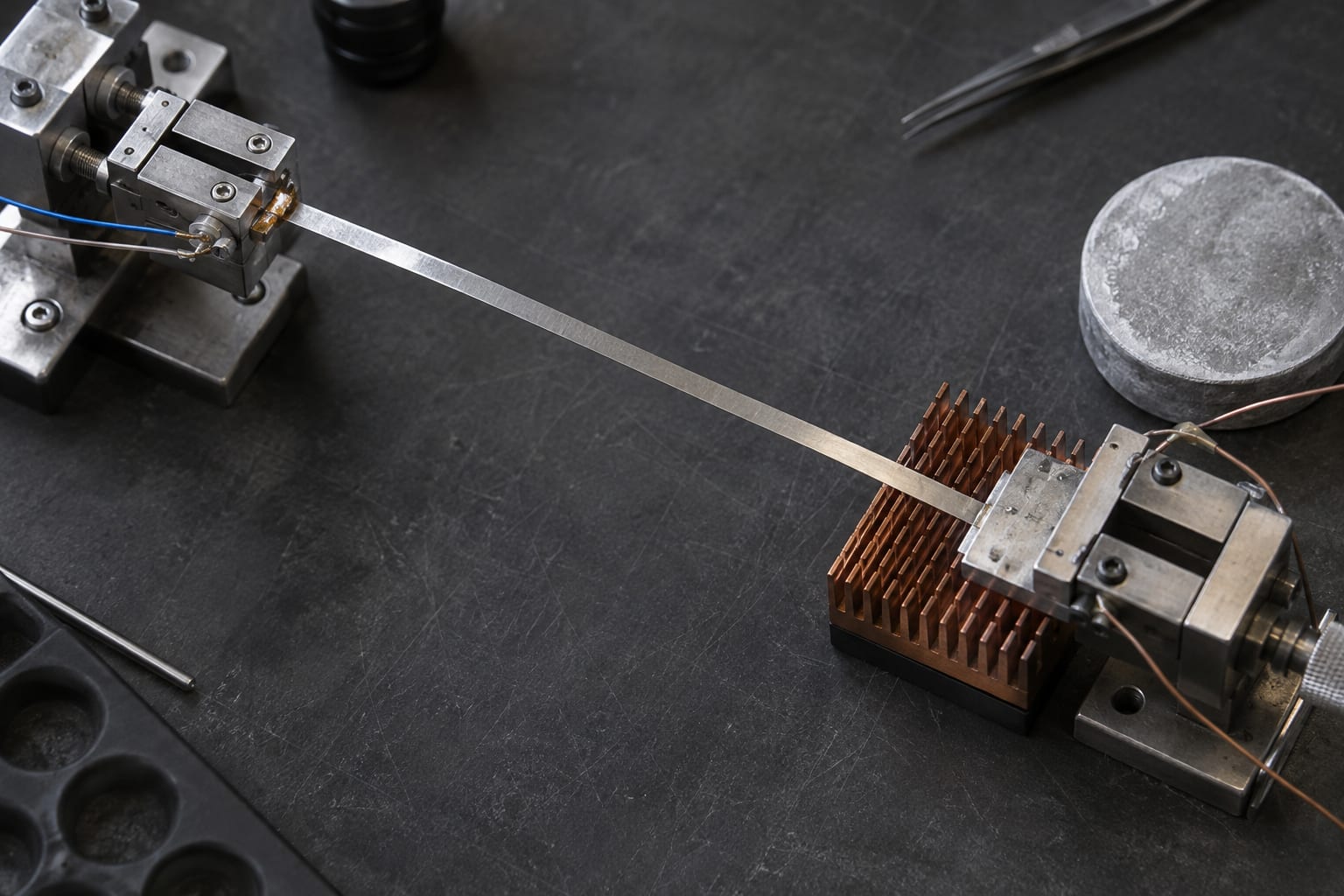
That does not invalidate the experiment. An electrically heated block is a controllable stand-in for any sufficiently hot source, and the energy reaching the shape-memory actuator arrived as heat across a physical interface. It does mean that descriptions of the demonstrated device as electricity-free skip over important machinery.
A fairer description is that the researchers replaced the actuator that strains the refrigerant with a heat-driven one. Building a complete cooler that minimizes or eliminates auxiliary electrical power remains another engineering problem.
Efficiency also needs work. In the Joule-heated experiment, the refrigerant unit alone had a reported coefficient of performance of 2.61 when calculated without recovering mechanical work. Once the thermal actuator's input was included, the full-system figure fell to 0.0853. The paper does not provide an equally clear full-system number for the externally heated configuration in its main text.
Then there is durability. The separate refrigerant film survived more than 2,000 loading cycles without observable degradation, while the assembled Joule-heated device completed an 80-cycle, 96-second stability test. Commercial cooling equipment must operate for vastly longer.
Independent reviews of elastocaloric technology identify the same broad obstacles: material fatigue, heat transfer, whole-system efficiency, cost and the recovery of mechanical energy between cycles.
The researchers propose increasing capacity by placing more films in parallel and increasing temperature span through multistage designs. That introduces new problems, including uniform heating, synchronized motion and equal stress across many films. The 130 °C source used in the external-heat experiment is also hotter than much of the waste heat available from ordinary electronics.
So this device is not about to cool a data center with its own exhaust heat. Its achievement is narrower and, in a way, more satisfying: a mechanism that previously existed largely in models has now moved heat on a laboratory bench.
One metal film took in heat and turned it into a pull. Another took that pull and turned it into cold. The resulting cooler is tiny, inefficient and incomplete, but the relay itself works.
Sources / further reading
Keep exploring


