The Crystal That Weaves Its Own Electric Fabric
Slow cooling caused electric-polarization domains to pass over and under one another inside a rigid crystal. Green light could locally pull the microscopic weave apart.
A crystal is about the last place you would expect to find weaving. Fabric works because flexible threads can bend, cross and loop around one another. A crystal, by contrast, is the textbook example of rigid order.
Yet when researchers slowly cooled a transparent ferroelectric crystal, its internal electrical structure rearranged into something remarkably textile-like. Microscopic domain bundles crossed over and under one another, forming an irregular three-dimensional network. The solid itself did not bend into threads. Its surface remained smooth, and no corresponding physical deformation was detected.
The weaving happened in the crystal's electric polarization.
The international team described the structure in a peer-reviewed paper published in Light: Science & Applications. Their result does not yet amount to a new memory device, despite the possibilities raised in the paper. It is first a stranger and more fundamental discovery: ordered matter found an unexpectedly elaborate way to organize itself.
What is actually being woven?
The material is potassium lithium tantalate niobate, or KTN:Li, a ferroelectric perovskite. Below a characteristic temperature, a ferroelectric develops spontaneous electric polarization. Small displacements of positive and negative charge create microscopic electric dipoles, and many dipoles pointing in a common direction form a domain.
The boundaries between those domains are movable. Change the temperature, electric field or illumination, and the crystal's internal polarization map can change even though the object remains solid.
The sample in this experiment had another important feature. Its growth process had left behind regularly spaced variations in chemical composition, called striations. Those variations caused the local transition temperature to shift slightly across the crystal, giving new domains a pre-existing pattern on which to organize.
The striations were not originally created to make an electric textile. Aharon Agranat and colleagues had developed such composition gratings for electro-optic switching years earlier. They turned out to provide the loom for something much less expected.
The crystal's average Curie temperature, the point around which it changes from its higher-symmetry, non-ferroelectric phase, was 292 kelvins, or about 19 °C. When the researchers cooled it at less than 0.4 kelvin per minute, a lattice of polarization domains began changing roughly 2 kelvins below that transition.
Then the crossings acquired depth.
Two diagonal families of domain bundles no longer appeared simply to intersect in a flat plane. Images taken at successive focal depths indicated that one passed above the other at one crossing, then the ordering could reverse at another. The resulting pattern repeated on a scale of about 10 micrometers.

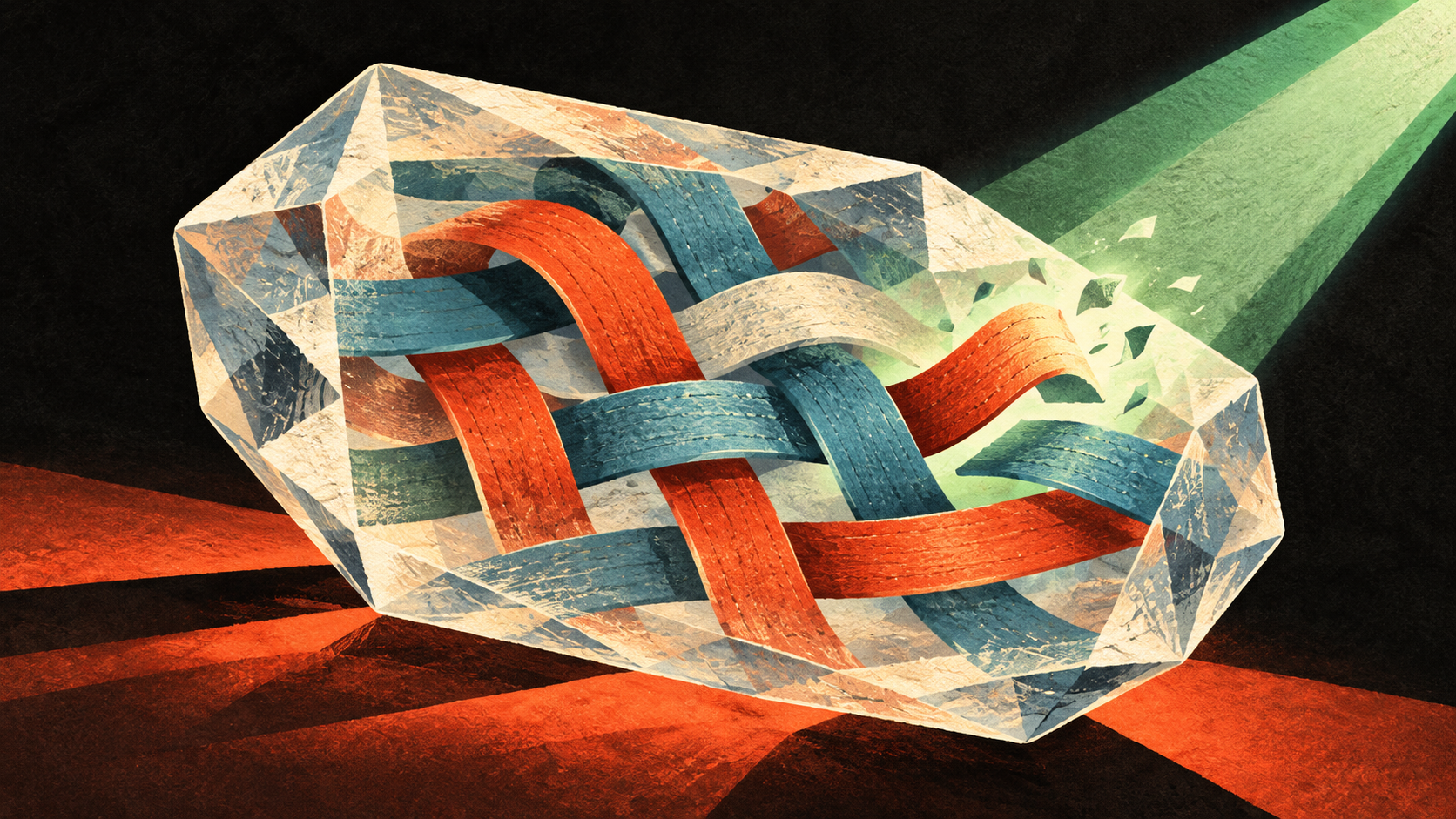
That scale matters. Some descriptions call the discovery nanoscale because the domains are made from ensembles of tiny electric dipoles. But the reported fabric itself is micrometer-scale and visible with optical microscopy. It is extremely small, but it is not an atomic loom.
How do you see a weave inside a solid?
A single flat image would not be enough. Two lines can cross in a photograph without being linked in three dimensions.
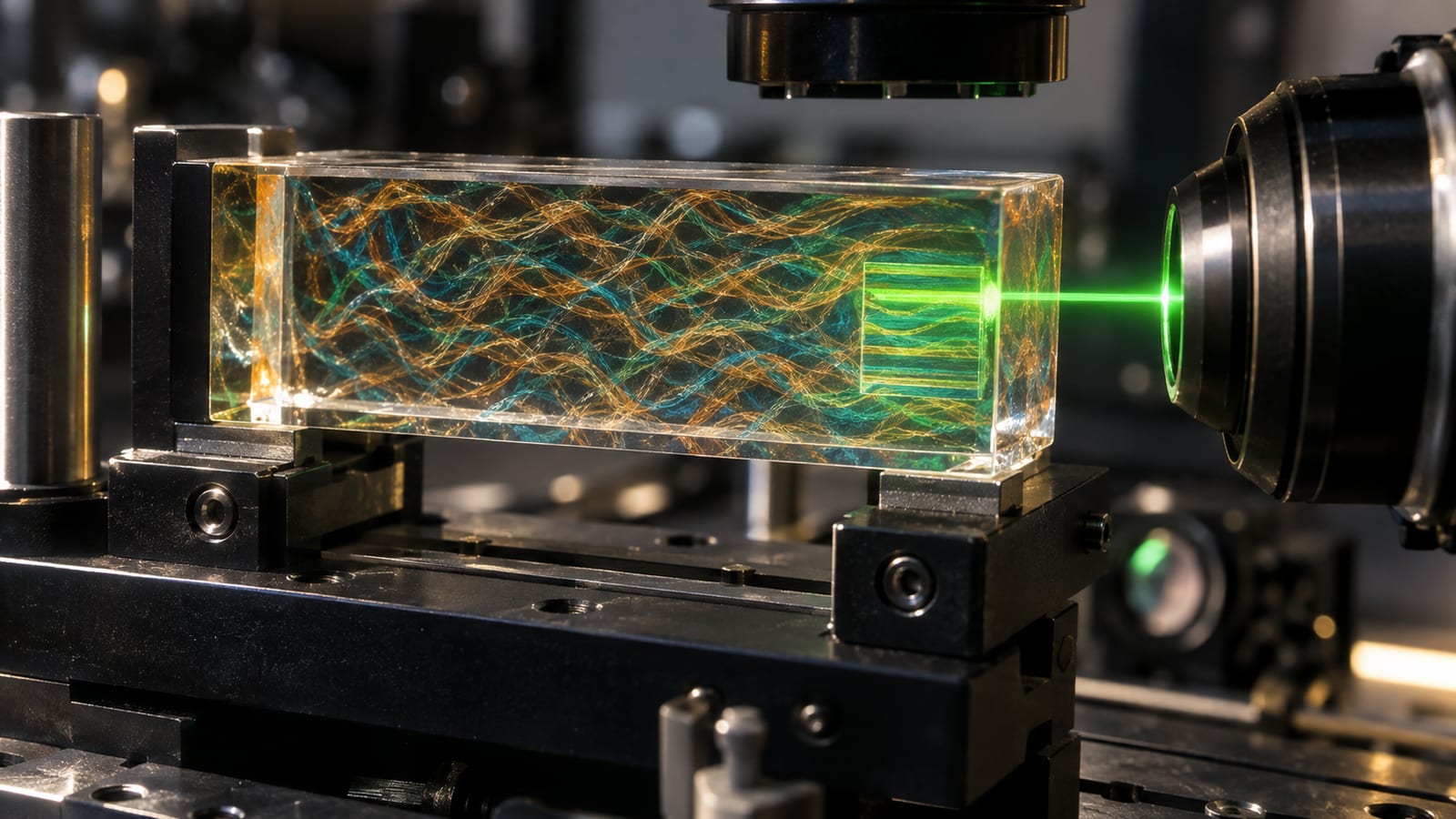
The researchers therefore combined several methods. They used polarized white-light and phase-contrast microscopy to exploit differences in how the domains interact with light. By moving the sample through the microscope's focal plane, they recorded slices at different depths, including 0, −8, −16 and −24 micrometers. Features that disappeared at one depth and reappeared at another supplied the over-and-under evidence.
Piezoresponse-force microscopy measured the polarization where the weave reached the surface. Raman imaging provided information about domain orientation through the crystal's vibrational spectrum. Second-harmonic-generation microscopy offered another polarization-sensitive view.
Together, those measurements support the existence of a three-dimensional interlaced structure near the surface. They also showed that the apparent threads were electrical domains rather than ridges, fibers or cracks: the measured surface topography stayed smooth.
The pattern was not a perfectly regular checkerboard. Each crossing could have a different local orientation, and repeating the heating-and-cooling cycle produced another weave with a new distribution of crossings. Once formed and held at a fixed temperature, however, an individual pattern remained unchanged in tests lasting up to six hours.
The woven state also occupied a narrow thermal window. It appeared between approximately 2 and 8 kelvins below the Curie temperature. Cooling farther caused many domain walls to disappear. Faster cooling did not produce the same weave at all.
That history dependence is a clue. The weave appears to be a metastable arrangement: not the lowest-energy configuration available, but one trapped behind a barrier created by its geometry.
Why the crossings may be hard to remove
At some crossings, the team's polarization model produces head-to-head or tail-to-tail arrangements. These are charged domain walls, where polarization creates bound electrical charge. Such walls cost energy and might ordinarily be expected to relax away.
The researchers argue that interlacing prevents them from doing so easily. Changing one crossing is not merely a local adjustment; it can require rearranging an extended network. That is the sense in which the authors call the structure topologically protected.
The phrase deserves restraint. The experiment established a persistent, linked pattern and showed that a suitable disturbance could change it. It did not establish that the fabric can survive every kind of noise, nor that it is ready to store data reliably for years.
A follow-on phase-field modeling preprint, submitted in August 2026 by P. G. Kubendran Amos, has explored how the geometry might arise. In those simulations, slow cooling created a window in which frustrated crossings could persist and separate in depth, while fast cooling did not. Across three simulated runs, 73 to 77 percent of slow-cooled crossings satisfied the model's weave criterion; none of the fast-cooled crossings did.

That is suggestive rather than conclusive. The preprint has not been peer reviewed, its parameters were not calibrated to the actual KTN:Li crystal, and the model did not reproduce the weave's disappearance at lower temperatures. It offers a possible mechanism, not an independent experimental replication.
A laser can unweave it
The experiment's most striking act of control used green light. The researchers focused a 514-nanometer laser to a spot about 0.8 micrometers across and scanned it over a 20-by-20-micrometer region. Inside the illuminated area, the interlaced pattern changed into a simpler, unlinked arrangement dominated by one family of diagonal domains. The surrounding weave remained.
Heating the crystal through its transition and cooling it again restored weaving, although the new pattern did not reproduce the old crossing sequence.
The exact optical mechanism remains unsettled. The authors' leading explanation involves photorefraction: light releases charge carriers from impurities, those carriers screen the bound charge at domain walls, and the woven structure becomes free to relax into a lower-energy configuration. The fact that the transformation accumulated over time supports that picture. A 1040-nanometer laser used for imaging did not produce the same disentanglement.
This is not yet practical laser-written memory. The reported green beam was intense, the scan paused for one second at every half-micrometer step, and the experiment removed a family of threads rather than setting arbitrary crossings to chosen values. There are no demonstrated bits, endurance figures, retention tests beyond six hours or integrated readout system.
But it does establish that the pattern is not merely a frozen curiosity. Parts of it can be changed without physically machining the crystal.
Earlier work by several of the same researchers had already found three-dimensional topological domain dynamics in KTN:Li. The new result pushes that idea into a geometry familiar from the human-scale world but deeply unusual inside a solid.
The crystal has not learned to make cloth. It has done something more precise: under the right cooling conditions, its electric order uses the third dimension to pass one domain around another. A compositional pattern engineered for optical switching becomes a template, the phase transition supplies the motion, and topology helps hold the result in place.
The loom, in this case, is the act of cooling.
Sources / further reading
- Xin et al., Spontaneous formation and optical manipulation of a woven domain fabric in a ferroelectric crystal
- Amos, Mechanistic Phase-Field Modelling of Woven-Domain Formation in Ferroelectric Material
- Xin et al., Evidence of 3D Topological-Domain Dynamics in KTN:Li Polarization-Supercrystal Formation
- Agranat et al., Stable electro-optic striation grating produced by programed periodic modulation of the growth temperature
Keep exploring


