Scientists Printed Images by Foaming Plastic From the Inside
Patterned ultraviolet light and a solvent bath can turn selected regions of a clear polymer into microscopic foam, producing structural white, diffractive colour and even water-repellent surfaces.

The image begins as a transparent sheet of plastic.
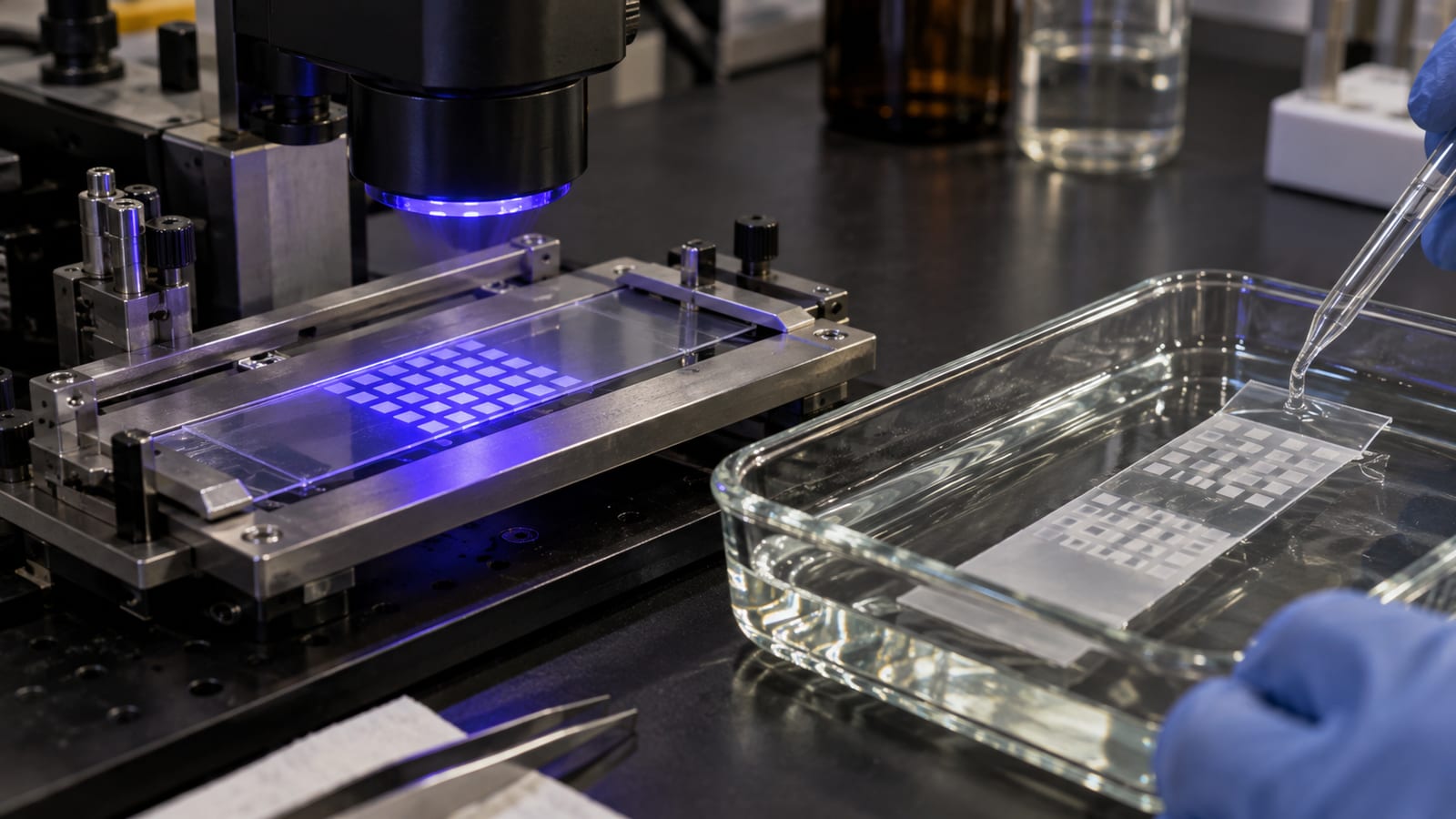
No white ink lands on it. No toner sticks to its surface. Instead, ultraviolet light writes an invisible chemical pattern into the film. A solvent bath then develops that pattern by turning selected parts of the plastic into microscopic foam.
The result can be a white portrait, a greyscale photograph or an image whose colour changes when it is tilted. Under different conditions, the same basic process can make a surface repel water, guide liquid through tiny channels or capture droplets measured in trillionths of a litre.
In one experiment, the foam dots averaged just 1.32 micrometres across. Converting that diameter into a nominal dot density gives 19,240 dots per inch.
A research team led by Kyoto University calls the method deep-foam photolithography, or DFP. Its peer-reviewed paper was published in Nature on September 9, 2026.
The remarkable part is not simply that the team made very small marks. It is that the demonstrated functions emerged from patterned pore architecture, and, in some cases, the surface topography that architecture created.
Light writes the instructions
The process starts with a thin polymer film containing a light-sensitive additive called a photoinitiator. The researchers primarily studied polystyrene mixed with thioxanthone, although they also demonstrated the method with polycarbonate, PET, PMMA, polysulfone and cellulose triacetate.
A patterned source shines UV-A light onto the film. In the illuminated regions, the photoinitiator starts two competing reactions. Some polymer chains break into shorter fragments, while others become crosslinked into a network.
That chemical compromise is essential. If the light merely destroyed the polymer, there would be nothing left to hold a structure. If it only crosslinked the chains, the next stage could not remove enough material to make pores.
The exposed film is immersed in what polymer scientists call a weak solvent, often acetic acid in the polystyrene experiments. “Weak” describes how the liquid interacts with that polymer; it is not a general safety or environmental label.
The solvent advances into the exposed film with a relatively sharp front. It interacts more readily with the shortened chains and chemically modified regions, producing solvent-rich pockets inside the surviving crosslinked network. Those pockets nucleate and expand into pores. Once the film is dried, the liquid leaves and the pores become air-filled cells.
The material has foamed from within.
Adding a photoinitiator is what makes the process genuinely deep. In a control experiment without one, two hours of shorter-wavelength ultraviolet exposure produced foam only a few micrometres below the surface of a 6.1-micrometre polystyrene film. With thioxanthone and more deeply penetrating 385-nanometre light, the researchers began with a 120-micrometre film and produced an expanded foam extending hundreds of micrometres.
The development bath is also a clock
The structure keeps changing while the solvent remains in the film.
At first, new pores appear as the solvent front moves downward. The pores expand, the film thickens and the material becomes an open microscopic foam. With further development, cell walls can rupture and soluble fragments escape. The crosslinked structure then relaxes and collapses.

That would normally sound like a manufacturing failure. Here, it becomes another tool.
Stopping development while the foam is expanded creates a thick, highly porous structure. Allowing controlled collapse creates a thinner surface with increasingly complex roughness. Altering the UV dose changes how much foam develops, which changes how strongly the region scatters light.
The process can therefore control more than where a mark appears. It can tune local thickness, porosity, whiteness and wetting behaviour.
White made mostly from air
A transparent solid contains relatively few internal boundaries to scatter visible light. A foam contains an enormous number of boundaries between polymer and air. Light repeatedly changes direction at those interfaces, scattering across the visible spectrum and making the material appear white.
It is the same broad optical idea behind the whiteness of snow, clouds, paper fibres and the unusually white scales of some beetles. The colour comes from structure rather than a white molecule or mineral particle.
The researchers used different exposure levels to print a greyscale portrait of Albert Einstein. Stronger exposure produced more developed foam and a whiter region; weaker exposure produced grey. The film itself supplied the contrast.
For the highest-resolution test, a maskless micro-LED system projected 405-nanometre light onto a 2.5-micrometre polystyrene film. The team measured 962 dots and found a mean equivalent circular diameter of 1.32 micrometres, with a standard deviation of 0.10 micrometres. That measurement, documented in the paper’s Supplementary Information, is the basis of the rounded claim of about 20,000 dpi.
The number needs its laboratory conditions attached. It is an equivalent calculated from mean dot diameter, not a universal rating for every polymer, exposure or development time. Nor does it map neatly onto the way manufacturers advertise desktop printers.
Foam growth also sets a practical limit. Neighbouring features expand toward one another as development continues. In a pattern with one-micrometre exposed lines separated by two-micrometre unexposed intervals, the remaining flat gap measured 1.6 micrometres after 95 seconds of development, 0.7 micrometres after five minutes and no more than 0.3 micrometres after two hours.
More development can build a more substantial foam while erasing the boundaries between tiny features.
At this scale, regular lines can also function as diffraction gratings. The team printed a tiny version of Vermeer’s Girl with a Pearl Earring using periodic foamed lines. When the sample was rotated, its apparent colour shifted from red toward violet.
This is different from the structural white. The white comes from disordered pores scattering many wavelengths. The colour comes from an ordered pattern sending different wavelengths in different directions.
When collapsed foam behaves like a lotus leaf
Polycarbonate produced another transformation. As its foam collapsed, the surface developed structures resembling microscopic flowers decorated with much finer needle-like features.
That hierarchy of roughness can trap air beneath a water droplet, reducing contact between the water and the solid. In the researchers’ quasi-static measurement, a two-microlitre droplet reached a contact angle of approximately 164 degrees when pressed most strongly against the surface.

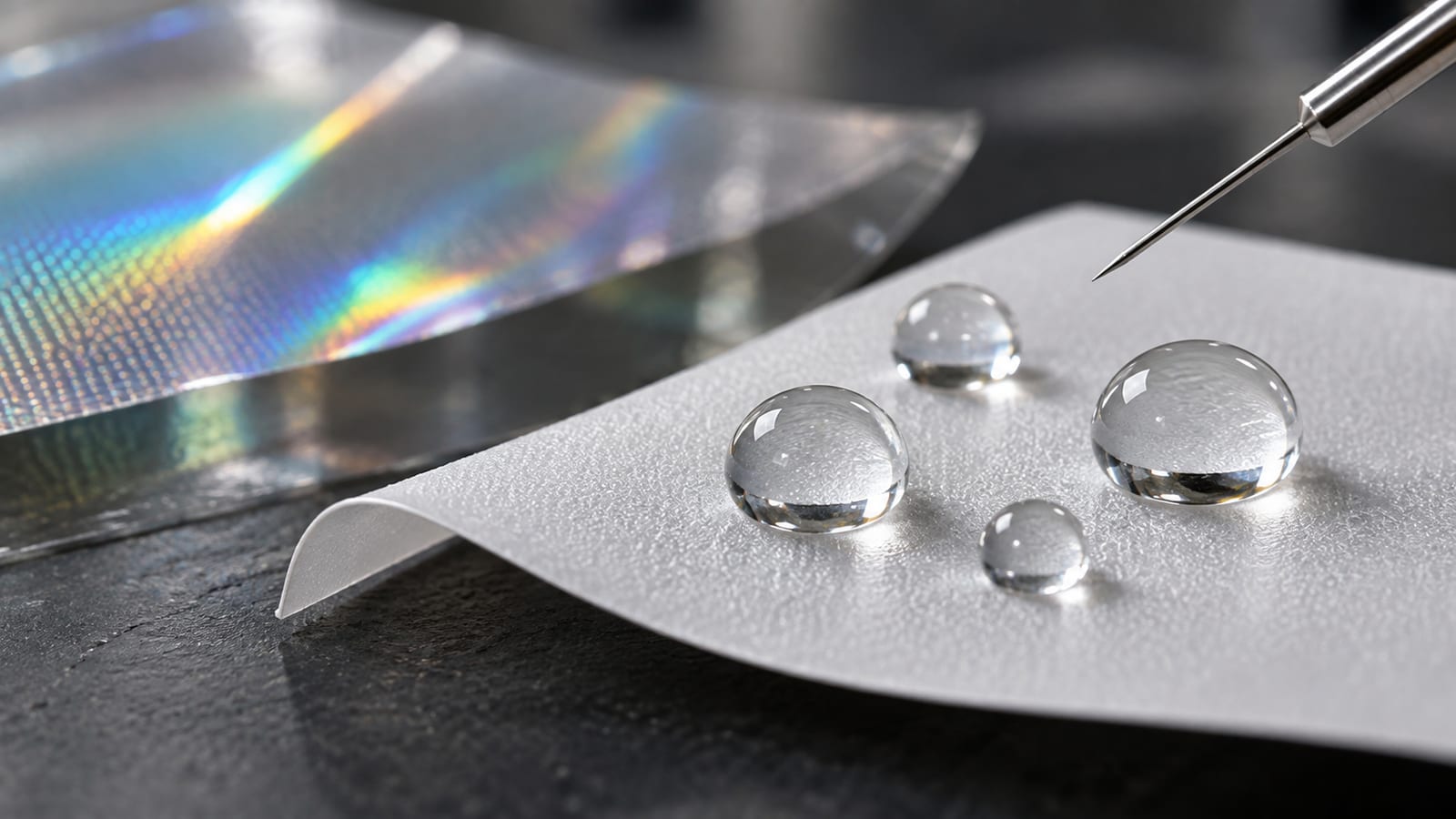
Contact angles above 150 degrees are commonly associated with superhydrophobic surfaces, but that number is not a complete wetting test. Adhesion, contact-angle hysteresis and roll-off behaviour also matter. The study additionally showed droplets being repelled, but it did not turn one static measurement into a complete durability record.
The chemical identity of the plastic mattered, too. Collapsed polystyrene became rough but did not develop the same nanoscale decoration and did not become superhydrophobic under the compared conditions.
By exposing only selected areas of polycarbonate, the researchers printed differences in water repellency. Water moved away from the collapsed foam but remained on less-hydrophobic regions. A large droplet drawn across one pattern left tiny isolated volumes behind. A colloidal suspension could similarly deposit particles in designated squares.
The paper describes capture at the picolitre scale, a picolitre is one trillionth of a litre, and shows a pump-free microfluidic channel in a foamed polystyrene film. These are proofs of concept. As the public peer-review file records, reviewers questioned how rapid evaporation would affect such small liquid volumes and challenged aspects of the initial microfluidics discussion. The authors reduced that emphasis and left fuller investigation for future work.
The process also worked on electrospun fibre mats. Patterned polycarbonate fibres selectively held coloured water, while foamed polystyrene fibres strongly scattered light. That makes textiles a plausible research direction, not a finished application.
A platform, not yet a production line
The team did move beyond microscope-sized specimens. It bar-coated polymer onto flexible sheets, printed a visually uniform array of dots across an A4-sized sample and enlarged an Einstein image to A3. The A4 uniformity test was a single, explicitly unoptimized trial, according to the Supplementary Information.
Preliminary durability tests were encouraging but mixed. A foamed pattern remained macroscopically visible after 50 liquid-nitrogen thermal-shock cycles and 1,200 bending cycles. Integrated direct-transmittance intensity varied by less than 3 percent after thermal shock and by 3.5 percent during the bending test. Electron microscopy nevertheless revealed cracks, including stress-whitening cracks about 15 micrometres apart in unfoamed regions. Pores appeared to interrupt some cracks in the foam, but long-term fracture behaviour remains untested.
There are other practical complications. The method requires a photoinitiator, substantial UV exposure, a solvent-development bath and carefully controlled drying. Different plastics require different solvent mixtures. Some film-preparation experiments used chloroform, DMF or trifluoroacetic acid. Industrial throughput, cost, chemical recovery, recycling and years-long durability have not been established.
No independent replication was identified during this review, conducted on September 14, 2026, five days after the paper appeared. That is a dated search finding, not an absolute claim that no replication exists.
The same restraint is necessary when discussing environmental benefits. The demonstrated white regions contain no titanium-dioxide pigment, and the water-repellent polycarbonate does not rely on a fluorinated coating. Those are potentially useful substitutions. They do not prove that the complete manufacturing process has a smaller environmental footprint.
What the research does establish is a strange and powerful piece of manufacturing logic. The polymer is not merely a surface waiting to receive an image. Its internal structure becomes the image, and, depending on how that structure develops or collapses, a diffraction grating, a water-repellent texture or a tiny liquid-handling device.
The ultraviolet light decides where the transformation can happen. The solvent makes it happen. And the pores, normally defects a manufacturer might try to eliminate, do the useful work.
Sources / further reading
Keep exploring


