Tiny Worlds Beyond Neptune May Still Remember How Planets Were Made
Webb found 27 new objects in a sliver of sky, while Hubble helped measure their colors. Their faint light suggests that the outer solar system has preserved a surprisingly stubborn record of its birth.

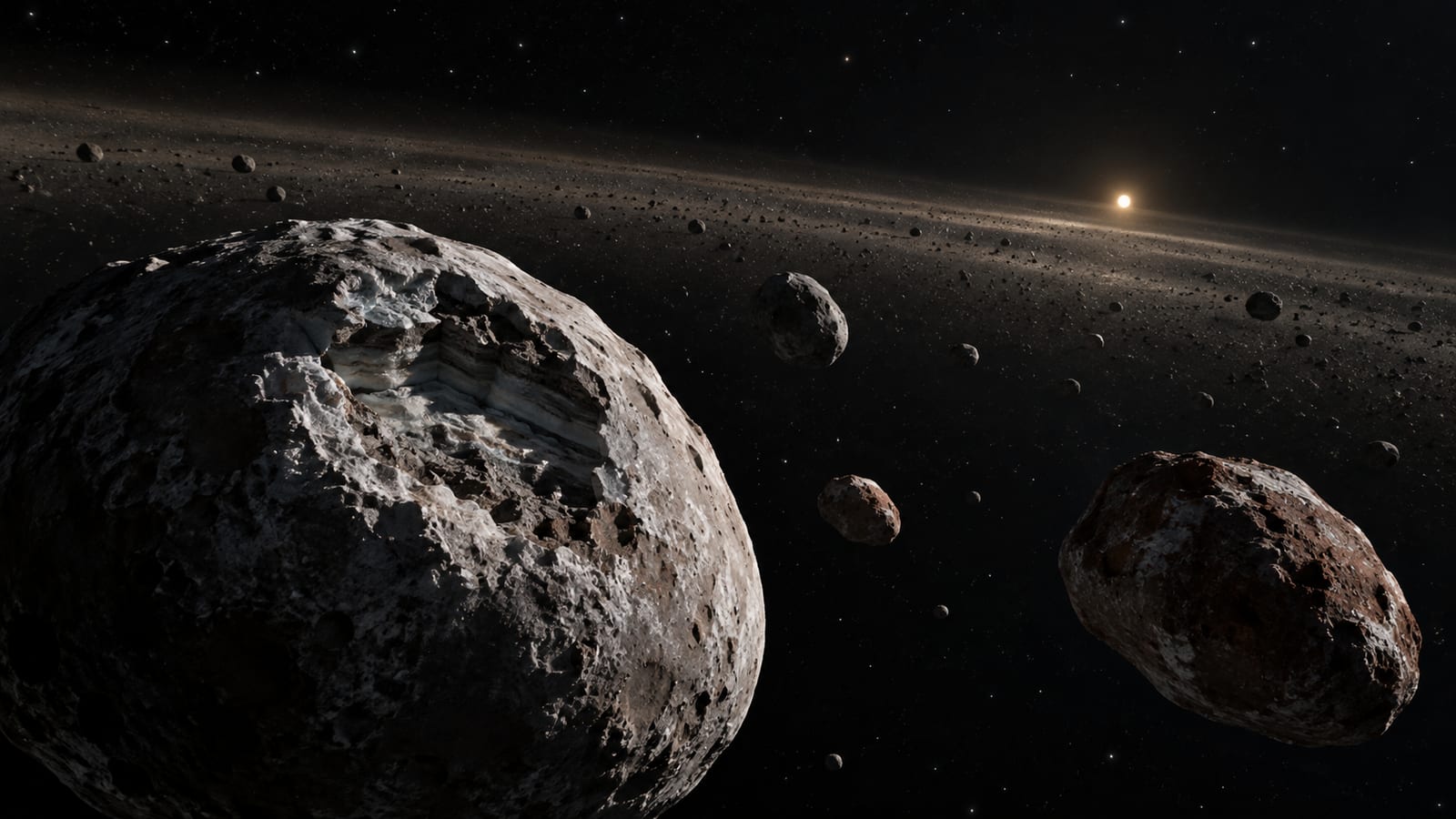
A five-kilometer world beyond Neptune is not a world in any photographable sense. Even to the James Webb Space Telescope, it is a dim point moving across a field crowded with stars and galaxies. Its shape is invisible. Its craters are unknowable. Its surface is compressed into a few measurements of light.
That light may nevertheless carry a record from the birth of the solar system.
In a pair of studies published in The Astronomical Journal, researchers used Webb to identify 27 new trans-Neptunian objects, or TNOs, and Hubble to help measure the colors of a subset. The objects belong to populations with very different orbital histories, yet they preserve patterns seen among much larger bodies: one population remains consistently reddish, another remains compositionally diverse, and both appear to contain similar proportions of small and large objects.
The result does not mean that individual surfaces have remained perfectly untouched for more than four billion years. The “memory” is statistical. It appears in the colors and numbers of an entire population, and in the surprising difficulty of erasing those patterns.
Finding a moving speck beneath the noise
TNOs orbit beyond Neptune, generally tens of astronomical units from the Sun. At those distances, a city-sized object reflects almost no sunlight toward Earth. Most are more than 100 million times dimmer than the faintest objects visible to an unaided human eye, according to NASA’s account of the research.
The Webb survey did not simply take a long exposure and reveal 27 dots. The researchers observed the same 20-tile patch of sky three times between January 24 and February 4, 2023, with about five days between visits. They then tested possible paths that a distant solar-system body could have followed.
For each path, the images were shifted so that a real moving object would line up from exposure to exposure. When those shifted images were stacked, the object’s weak signal accumulated while unrelated noise did not. This technique, called shift-and-stack or digital tracking, can reveal a source that is not convincing in any single frame.
The team also implanted hundreds of artificial moving objects into the raw images to measure how often its pipeline recovered them. A machine-learning classifier rejected likely artifacts, pixel-level models tested whether the survivors behaved like moving point sources, and detections from different dates were linked to plausible orbits.
The resulting luminosity-function study describes the deepest dedicated search for TNOs yet conducted. It covered just 0.05 square degrees, roughly one-quarter of the apparent area of a full Moon, but reached about five times smaller in estimated diameter than the most sensitive ground-based searches.
There is an important catch in the word “size.” Webb did not measure these objects with a ruler, nor did it resolve their edges. Astronomers inferred diameter from brightness and distance while assuming how reflective the surfaces are. The smallest estimates land in the neighborhood of 5 to 10 kilometers, depending on the object and albedo assumption. A darker body reflects less light and may therefore be larger than an equally bright, more reflective one.
What the survey measured directly was a luminosity distribution: how many objects appeared at each brightness.
Cold and hot do not mean temperature
The researchers divided the distant bodies into two broad dynamical populations.
Cold classical TNOs follow relatively circular, low-inclination orbits. “Cold” describes the calmness of those orbits, not the objects’ physical temperature. They are thought to have formed near their present neighborhood, around 45 astronomical units from the Sun, and to have escaped much of the orbital upheaval caused by the migrating giant planets.


The dynamically excited, or “hot,” population occupies more inclined and eccentric orbits. Models suggest that many of these objects formed closer to the Sun, around 25 astronomical units in the comparison used by the study, and were scattered outward as the giant planets migrated.
Those birthplaces should have differed in temperature, density and collision rate. The two populations also look different. Larger cold classicals tend to have uniformly red surfaces associated with complex organic material, while excited objects span several reflectance and compositional classes.
Their orbits and colors therefore say that these are not simply two random samples from one interchangeable population.
That makes what happened at the small end especially interesting.
The colors stayed in the family
Webb supplied exceptionally sensitive near-infrared measurements, but color requires comparing light at separated wavelengths. Hubble provided the visible-light side of that comparison.
The coordinated Hubble program was substantial: 99 orbits across nine pointings. Even then, it covered only about 65% of Webb’s survey footprint. Fourteen of the selected Webb objects passed through the Hubble fields, and the team recovered 13 of them.
During Hubble’s roughly 20-minute exposures, each target moved far enough to leave a short trail. The researchers modeled the telescope’s point-spread function along the predicted curved path, then combined the Hubble and Webb measurements while accounting for rotational changes in brightness. The resulting colors spanned wavelengths from approximately 0.35 to 3.2 micrometers.
The color study found that the small cold classical objects occupied the same narrow reflectance sequence previously identified among larger cold classicals. Their measurements were consistent with organics-rich surface types.
Small dynamically excited objects, by contrast, showed the same broad color diversity found among their larger relatives, spanning reflectance patterns associated with water ice, carbon dioxide and organic-rich surfaces.
Broadband color is not a complete chemical analysis. It shows how strongly a surface reflects different parts of the spectrum, and several mixtures can sometimes produce similar colors. But as a population-level fingerprint, the distinction is striking. When the new sample was compared with earlier Webb spectroscopy of larger TNOs, the familiar color split persisted across estimated diameters from roughly 5 to 700 kilometers.
If small TNOs were mostly fragments repeatedly excavated and resurfaced by collisions, researchers expected their colors to drift away from the patterns seen among larger objects. They did not detect that drift.
That does not prove the surfaces avoided every collision. Radiation can also alter exposed ice, and a broad color class may survive processing that changes finer chemical details. What the observations show is that whatever happened after formation was not enough to erase the major population differences.

A strangely similar supply of sizes
The second result comes from counting objects at different brightnesses.
The cold and excited samples both followed shallow luminosity distributions, with slopes that were statistically indistinguishable in this dataset. In plain language, their numbers changed with brightness at almost the same rate. Under reasonable reflectivity assumptions, that implies similarly shaped size distributions.
This is unexpected because the populations are thought to have formed in different parts of the young solar system’s disk. One region was colder and less dense; the other was warmer, denser and probably more collisionally active. Yet both appear to have produced, or preserved, nearly the same relative mixture of sizes.
The survey also found fewer very small objects than some previous extrapolations and formation models predicted. Its shallow slope indicates that most of the Kuiper Belt’s mass is stored not in innumerable tiny bodies but near a break in the distribution around 200 kilometers in diameter.
One possible explanation involves the streaming instability. In this model, pebble-sized solids moving through gas concentrate into dense clouds. Gravity then collapses those clouds rapidly into planetesimals, often tens or hundreds of kilometers across. If collapse requires a minimum concentration or mass, it could naturally produce relatively few small planetesimals.
The new observations are consistent with streaming instability followed by pebble-cloud collapse. They are not a unique proof of it. Collisions, changing reflectivity with size and the survey’s limited sample could all affect the distribution astronomers infer.
What “remembering” really means
The most tempting version of this story is that astronomers found pristine time capsules beyond Neptune. The evidence is more subtle, and more useful.
The study examined one tiny patch of sky. Only 13 objects contributed Hubble color measurements. Their diameters depend on assumed albedos, and the short observing arc left part of each orbit unconstrained. The boundary between the cold and excited samples is therefore practical rather than perfect. Both papers also came from the same coordinated campaign and overlapping group of researchers, so they complement each other rather than independently replicate one another.
Within those limits, two separate measurements point in the same direction. The small objects retain the color families of their larger relatives, and two dynamically distinct populations have surprisingly similar brightness distributions. Both results suggest that primordial patterns survived to far smaller scales than astronomers had been able to test before.
Future surveys can attack different parts of the problem. The Vera C. Rubin Observatory’s Legacy Survey of Space and Time should discover vastly more TNOs and sharpen comparisons between dynamical populations, although it will not reach the same faint objects as this Webb survey. More deep space-based fields, longer orbital tracking, stellar occultations and thermal measurements could test whether the inferred diameters and population patterns hold up.
For now, the distant objects remain points of light. But that is enough to make them useful fossils. The planets incorporated, heated and reworked much of the material that built them. Beyond Neptune, some of the leftovers stayed small, and may have kept the receipt.
Sources / further reading
- Eduardo et al., The Luminosity Function of Ultra-Faint Trans-Neptunian Objects Detected by JWST
- Morgan et al., Combined JWST and HST Deep Imaging to Characterize the Smallest Known Trans-Neptunian Objects
- NASA’s Hubble, Webb Find Far-out Solar System Objects ‘Remember’ Past
- Northern Arizona University: Study finds that far-out solar system objects ‘remember’ their past
Keep exploring


