The Origin of “Shit” Is Probably Not What You Think
No, it did not mean Ship High in Transit. The real story begins with an Anglo-Saxon stomach problem and somehow gets even better.
English has spent at least a thousand years getting its shit together.
Linguistically, at least.
Today, shit may be the hardest-working word in the language. It can identify a substance, describe a disaster, insult a person, dismiss an argument, inventory all your belongings or announce that you just dropped your phone in the toilet.
It can even reverse itself. Something terrible is “shit.” Something excellent is “the shit.” English learners deserve hazard pay.
According to one wonderfully tidy internet story, the word began when sailors stamped S-H-I-T on crates of manure. The letters supposedly meant “Ship High in Transit,” because wet manure could release methane and create a floating cargo hold full of terrible decisions.
It is a magnificent explanation. It has manure, explosions, sailors and an acronym that lands perfectly.
It is also complete crap.
The word missed the boat by about a thousand years
The problem with “Ship High in Transit” is that the word was already in English centuries before anyone supposedly painted those instructions on a manure crate.
The British Library holds a tenth-century medical manuscript called Bald's Leechbook. It contains remedies, diagnoses and charms copied between 940 and 955.
One passage describes food that was digested badly and became harmful fluid and scittan. In that sentence, scittan is a form of the Old English noun scitte, which the Bosworth-Toller Anglo-Saxon Dictionary defines as diarrhea or looseness of the bowels.
So the oldest surviving English evidence for shit is not a sailor warning about explosive cargo.
It is basically an Anglo-Saxon doctor writing, “This man has had a catastrophic afternoon.”
Yes, it probably sounded familiar
Old English spelling makes scitte look less recognizable than it probably sounded.
In Old English, the letters sc often represented the sound we now spell sh. The University of Glasgow's Old English guide gives a useful example: Old English scip became modern ship.
That means scitte already began with something close to the modern sound.


The word did not need a cargo label. It already had the pronunciation, the meaning and, apparently, a patient who needed to cancel the rest of his day.
The manuscript cannot tell us how offensive the word sounded in the tenth century. A medical reference is not an Anglo-Saxon survey of dinner-table manners. But it proves the word existed long before the shipping tale could have created it.
The internet puts poop on a boat
The false story usually goes like this: manure was loaded into a ship. Water reached the cargo. Methane accumulated. Somebody ordered the crates stored high above the waterline and stamped them “Ship High in Transit” or “Store High in Transit.” Eventually, the initials became the word.
There are several versions because the legend keeps changing whatever words are necessary to protect the acronym.
That is not etymology. It is acronym karaoke.
No early cargo document has surfaced with the instruction. More importantly, a medieval English stomach problem had already beaten the imaginary shipping clerk to the word by roughly a millennium.
The story survives because it feels satisfying. Four letters line up. The danger sounds plausible. The manure supplies its own special effects.
History remains unmoved.
The word brought relatives
English is not the only Germanic language with a related word. Dutch has schijten, German has scheissen and Old Norse had skíta.
The exact prehistoric family tree is debated, but the relatives make one fact obvious: an English shipping acronym cannot explain why similar words appeared across multiple Germanic languages.
The word arrived at the family reunion with cousins.
By Middle English, written examples become much easier to find. The Middle English Dictionary records forms of shīten meaning to defecate or discharge excrement.
A satire from around 1335 even uses a related spelling while insulting workers who handled foul-smelling liquid. Medieval employee appreciation programs were still in development.
Then English gave it every available job
Over the centuries, the word escaped the bathroom and applied for every vacancy in the language.

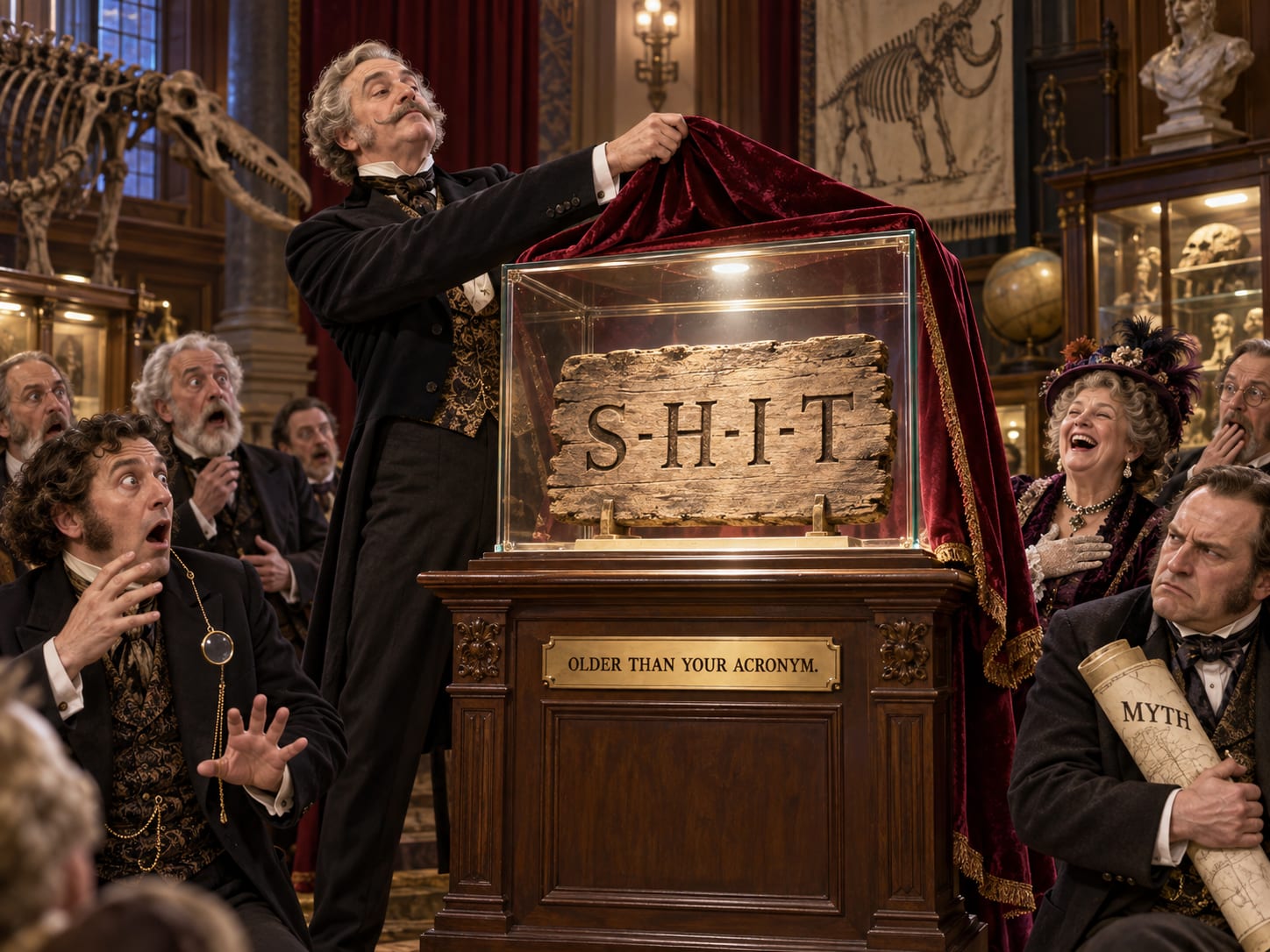
It became a noun, verb, insult, exclamation and general-purpose emergency announcement. It could mean nonsense, worthless material, a contemptible person, an unpleasant situation or all the random belongings currently living in your garage.
An 1844 diary contains one of the earliest currently identified written examples of shit used as a standalone exclamation. That does not mean the diarist invented it. It means his outburst survived while countless earlier people neglected to preserve theirs for historians.
Spoken profanity rarely pauses to notify the archives.
Is “shit” related to “science”?
One proposed deep origin connects the Germanic word to a prehistoric root meaning to cut, split or separate. That idea has inspired the irresistible claim that shit and science are extremely distant cousins.
It is possible, but not settled. The Indo-European Cognate Relationships database notes that the Proto-Germanic verb has no certain origin outside Germanic.
So “possibly connected through a reconstructed ancient root” is fair.
“Science and shit are definitely the same word” is the kind of sentence that reaches Facebook before the evidence has found its pants.
Fortunately, the verified history is already good enough.
A word recorded in an Anglo-Saxon medical manual survived medieval satire, traveled through a large Germanic family and became one of the most versatile words in modern English.
The real origin is older, stranger and much funnier than the tidy story on the internet.
The word is authentically ancient.
The shipping story is bullshit.
Sources / further reading
- British Library catalogue: Royal MS 12 D XVII
- Bosworth-Toller Anglo-Saxon Dictionary: scitte
- University of Glasgow: Old English orthography and pronunciation
- University of Michigan Middle English Dictionary: shīten
- University College Cork: Kildare Poems, Poem 3
- Jesse Sheidlower: Interjectional Shit in a Drunken 1844 Diary Entry
- IE-CoR Cognate Set 1309
- Merriam-Webster: shit
- Wordorigins.org: shit
- Bethany Christiansen: Scytel, A New Old English Word for Penis
Keep exploring


