Mars May Have Built a Complex Crust Without Plate Tectonics
A puzzling seismic layer beneath NASA’s InSight lander may be the residue of an ancient magma-processing system, evidence that a stagnant planet can build surprisingly complicated crust.

Mars’s crust appears to have a false bottom.
About 24 kilometres beneath NASA’s InSight lander, seismic waves suddenly speed up. On Earth, a jump like that can mark the Moho, the boundary where the crust ends and the mantle begins. But several analyses of InSight data place the modeled Martian crust-mantle boundary considerably deeper, near 38 kilometres.
That leaves roughly 14 kilometres of unusually fast material in geological limbo. It behaves seismically a little like mantle, yet the models place it within the crust.
A study published in Nature Astronomy offers an intriguing explanation: the layer may be dense residue from an ancient magma system that once processed material through much of Mars’s crust. If that interpretation is right, Mars accomplished a form of crustal differentiation often associated with Earth’s moving tectonic plates, even though the planet lacks Earth-style plate tectonics.
The result does not mean scientists found a vast cavern of molten rock beneath the InSight lander. What they found is subtler, and, in some ways, more interesting: a possible fossil structure left by magma that cooled and separated billions of years ago.
A boundary that did not quite fit
InSight listened to Mars from 2018 through 2022. Its extraordinarily sensitive SEIS instrument recorded vibrations from marsquakes and meteoroid impacts. As those vibrations moved through the planet, their speeds and paths changed with the properties of the rock.
The basic principle resembles medical imaging. Scientists cannot cut Mars open, but they can study waves that pass through it, reflect from boundaries and arrive at the detector by different routes.
There was one serious disadvantage: InSight was a single, stationary station. Earth seismologists can combine recordings from networks of instruments. On Mars, every inference had to be wrung from one listening post.
A 2023 analysis of nearby meteoroid impacts nevertheless produced a four-layer model beneath the lander. It combined surface waves detected from two impacts with P- and S-wave arrival information from five impact events, then checked candidate models against other seismic observations.
The resulting picture included shallow sediment and heavily fractured rock, followed by two deeper crustal layers. The modeled division between the deep layers sat at 24.5 kilometres, with a sizable uncertainty of 8.3 kilometres. A deeper inferred boundary, near 38 kilometres, was interpreted as the transition from crust to mantle.
Seismic velocity alone does not print a rock’s name on a screen. Temperature, pressure, porosity, mineral composition and fractures can all influence how waves travel. To identify the mystery layer, Tobermory Mackay-Champion and colleagues had to work backward from speed to stone.
Turning wave speeds into rock
The team compiled 883 possible Martian rock compositions from previous measurements and calculations. It divided relevant samples into two broad families.

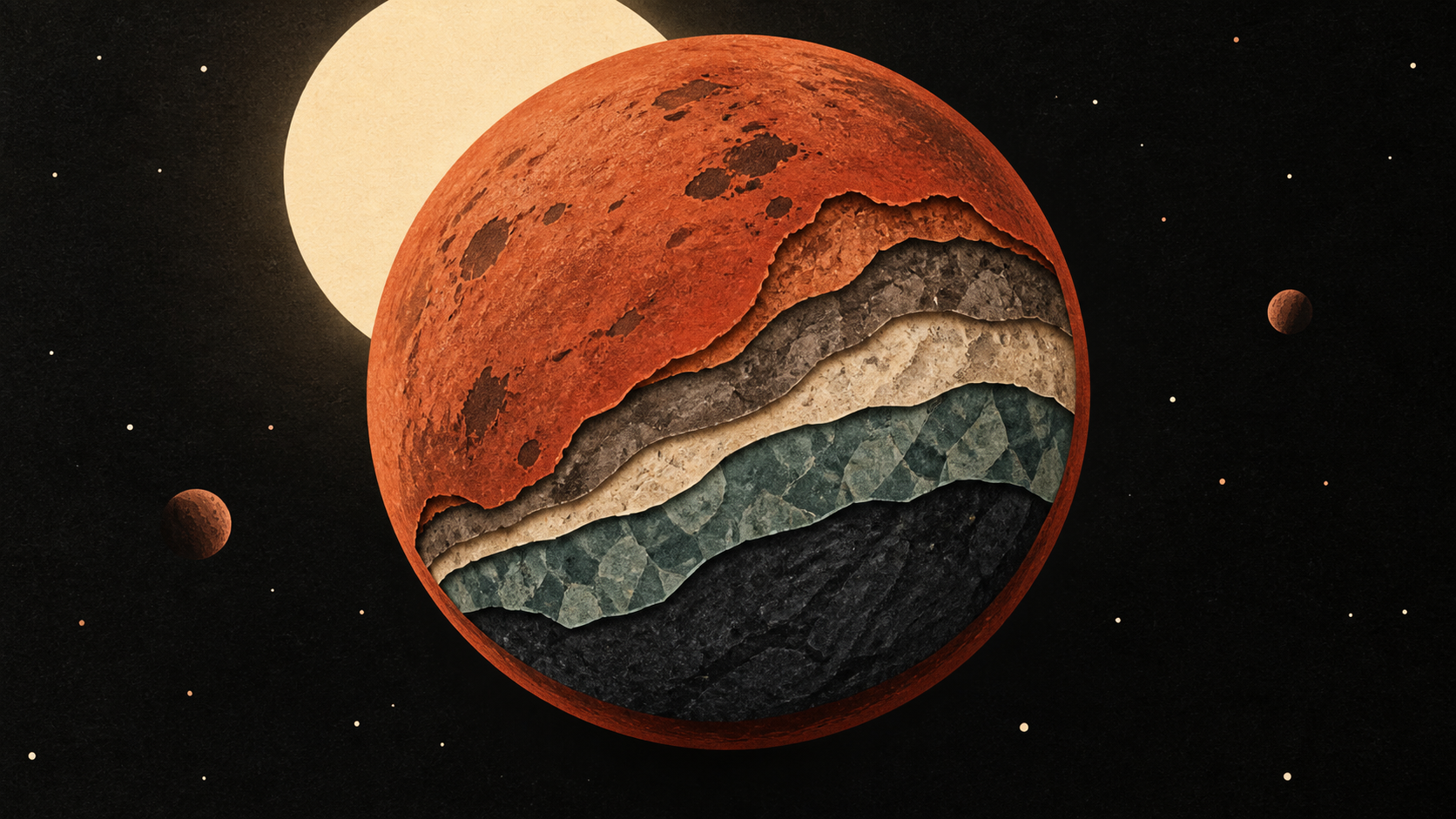
Mafic rocks, including basalt, contain substantial iron and magnesium. They make up much of the crust visible on Mars. Ultramafic rocks contain even less silica and proportionally more iron- and magnesium-rich minerals. Earth’s mantle is largely ultramafic, although ultramafic material can also form inside crustal magma systems.
Using thermodynamic software, the researchers calculated which minerals each candidate composition should contain under plausible Martian pressures and temperatures. They then calculated the P-wave and S-wave speeds expected through those mineral mixtures and compared the predictions with InSight’s seismic model.
The layer above the 24-kilometre boundary behaved more like mafic rock. The layer below behaved more like ultramafic rock.
With equal starting odds for the two choices, the analysis assigned an 85.9% probability that the upper layer was mafic and a 90.8% probability that the lower layer was ultramafic. Tests that varied temperature gradients, water content, oxidation state and the selection of rock samples continued to favor that pairing.
Those percentages need context. They express preference between models, not the probability that a drill would pull up a particular rock. The P-wave structure of the deep crust is also less certain than the S-wave structure. When the researchers removed the P-wave information and used a broader statistical test, the probabilities dropped to 64.0% for a mafic upper layer and 60.7% for an ultramafic lower one.
The preferred interpretation survived, but much less decisively.
That distinction captures the state of the evidence. InSight detected a layered crust. The claim that its lowest modeled layer is ultramafic is a tested interpretation of those data, not a direct observation.
The leftovers from a magma factory
If the lower layer is ultramafic, why does the model place it above the deeper inferred mantle boundary?
The researchers think it may consist of cumulates: crystals that accumulated as magma cooled and changed composition. Picture mantle-derived basaltic magma entering the bottom of the crust. Iron- and magnesium-rich minerals crystallize, separating from the remaining liquid and leaving a dense pile behind. The residual melt becomes more chemically evolved and buoyant, allowing it to rise.
Intruding magma also carries heat. Repeated injections could have partially melted surrounding crust, mixed old and new material, and fed reservoirs at progressively shallower depths. The result would not necessarily be one enormous liquid chamber. Modern geologists increasingly describe magmatic plumbing as an assortment of crystal-rich mushes, melt lenses, intrusions and temporary reservoirs.
Because the proposed system connected processes across much of the crust, the researchers call it transcrustal magmatism.
Their thermal calculations add another piece to the argument. Under most estimates of ordinary ancient Martian heat flow, rock between 24 and 38 kilometres would not become hot enough to melt. Among modeled heat flows from 5 to 45 milliwatts per square metre, only the hottest case produced melting within the crust, and only when the rock was water-saturated.

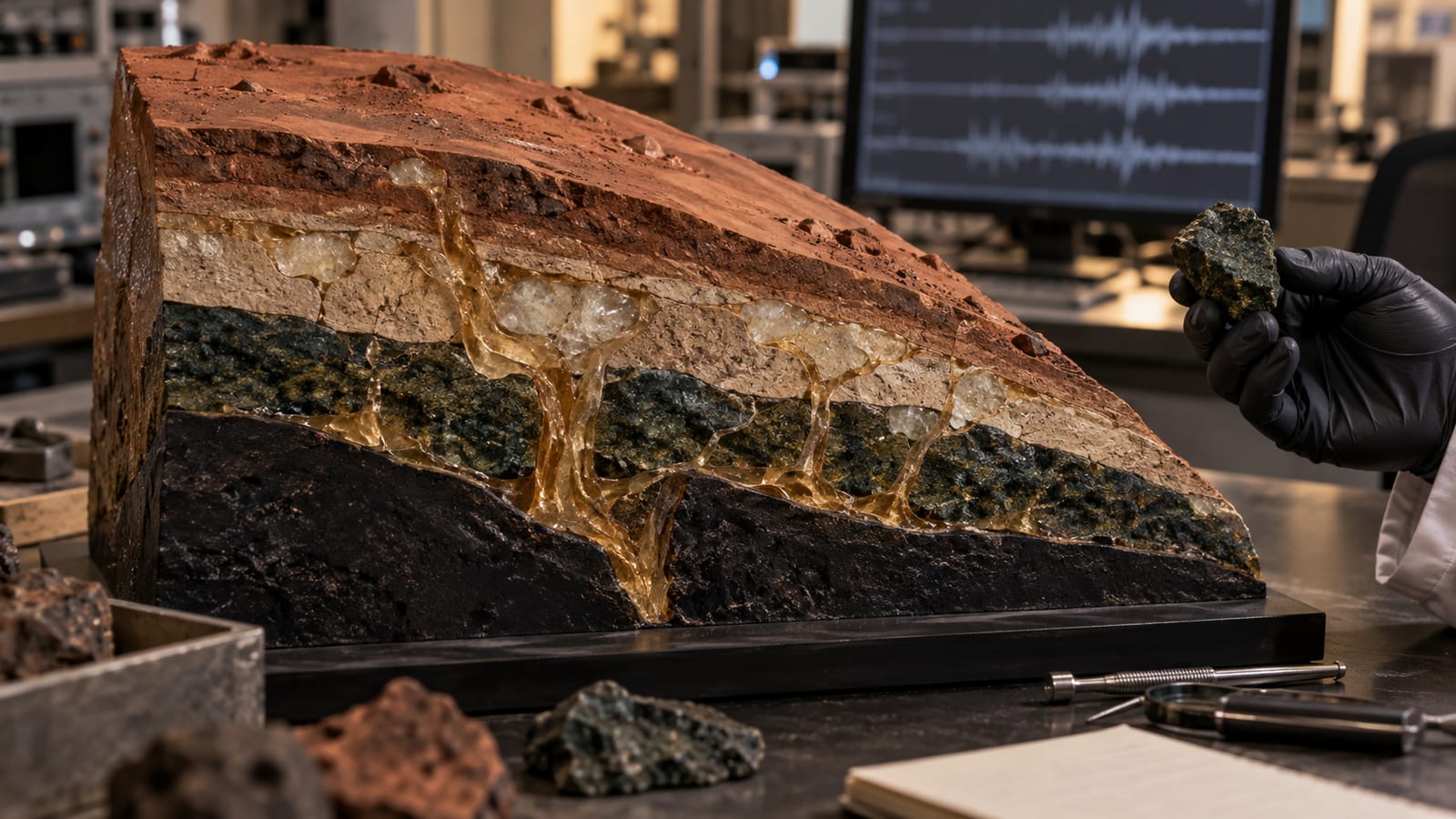
Something extra was therefore required. The paper’s favored explanation is mantle upwelling, which could have delivered both heat and new magma. Intrusions would differentiate as they cooled while also helping melt the crust around them. Dense residue would remain below; more evolved melt would move upward.
Mars may have recycled parts of its crust vertically, without the global conveyor belt of plate tectonics.
Complex geology on a stagnant planet
Earth’s crust is continually reworked. Plates spread, collide and sink, carrying water and rock into environments where melting and chemical separation can occur. That machinery helps Earth produce chemically varied crust instead of preserving a relatively simple shell of primordial volcanic rock.
Mars has no comparable system of moving plates. Its lithosphere is generally described as a stagnant lid. That does not mean the planet was geologically motionless, Mars built the largest volcanoes in the Solar System, but it raises questions about how extensively its crust could be processed.
The new interpretation suggests that a sufficiently hot, active interior can perform some of that chemical work without plate tectonics. Mantle upwelling and magma intrusion may create localized vertical systems that separate dense crystals from lighter melts and redistribute material through the crust.
Other observations make the idea plausible. Orbital spectroscopy has found silica-enhanced and feldspar-rich rocks elsewhere on Mars, while Martian meteorites record magmatic processes at different depths. Seismic studies have also identified a boundary around 20 to 24 kilometres across parts of the northern hemisphere.
But those pieces do not establish one continuous system. InSight sampled the planet from one location in Elysium Planitia, and planet-spanning seismic averages do not perfectly match the fast structure beneath the lander. The inferred ultramafic layer could vary greatly from place to place.
Planetary seismologist Doyeon Kim, who was not an author of the study, told APS Physics that the work adds an important petrological perspective, while emphasizing how difficult it is to infer three-dimensional composition from a single seismic station. Kim called the proposed system an exciting possibility and argued that Mars needs a denser seismic network.
That is the kind of evidence that could make the study’s elegant interpretation substantially firmer. Instruments spread across Mars could determine whether the mysterious deep layer is local, regional or widespread. Better gravity measurements and, eventually, samples from relevant terrain could test whether the expected ultramafic residue and evolved upper-crustal rocks are really there.
For now, the buried layer offers a remarkable possibility. Mars may not have needed plate tectonics to make a complicated crust. It may simply have moved the important material in a different direction: up.
Sources / further reading
Keep exploring


