Why Stink Bugs Try to Move Into Your House Every Fall
The brown marmorated stink bug is not trying to eat your house or start a family in the walls. It just wants free winter lodging, and the best time to deny entry is before check-in.

The first one is easy to dismiss: a mottled brown shield parked beside the front door. Then another appears on the siding. Another lands on the window screen. Soon it looks as if a very small, very unpopular convention has chosen your house as its hotel.
That is close to what is happening.
The insects gathering on homes every fall are often brown marmorated stink bugs, an invasive species called Halyomorpha halys. The adults are not looking for food, a mate or a cozy place to raise hundreds of babies. They are searching for a protected crevice where they can wait out winter.
Your siding, attic and wall voids offer exactly that, provided the bugs can find an unlocked side entrance.
This is not just any stink bug
North America has many stink bug species, including native predators that help control other insects. The notorious home invader is the brown marmorated stink bug, a species native to East Asia that was first officially identified in the United States near Allentown, Pennsylvania, in 2001. It was already established by then.
Adults are roughly the size of a dime, with a mottled brown, shield-shaped body. The most useful identification clue is the antennae: brown marmorated stink bugs have conspicuous pale bands on otherwise dark antennae. Alternating light and dark markings also run along the exposed edge of the abdomen.
That distinction matters. A brown shield shape alone does not make every bug an invasive home invader.
Outdoors, brown marmorated stink bugs can be serious agricultural pests. They pierce fruit, vegetables and field crops to feed, sometimes leaving scars, pits or damaged tissue. Indoors, their ambitions become much less impressive.
They mostly sit there.
Why the autumn rush happens
As days shorten in late summer and early fall, adult brown marmorated stink bugs begin preparing for a dormant state called diapause. In natural settings they can spend winter inside tight, dry spaces beneath loose bark. A house offers thousands of artificial versions of the same thing.
University of Maryland Extension reports that the adults tend to congregate on warm, elevated surfaces before entering buildings. EPA guidance says they commonly appear near doors, windows and other openings in early autumn. A peer-reviewed study involving USDA Agricultural Research Service scientists found that shorter day length, with a smaller contribution from temperature, helps trigger the search for overwintering shelter.

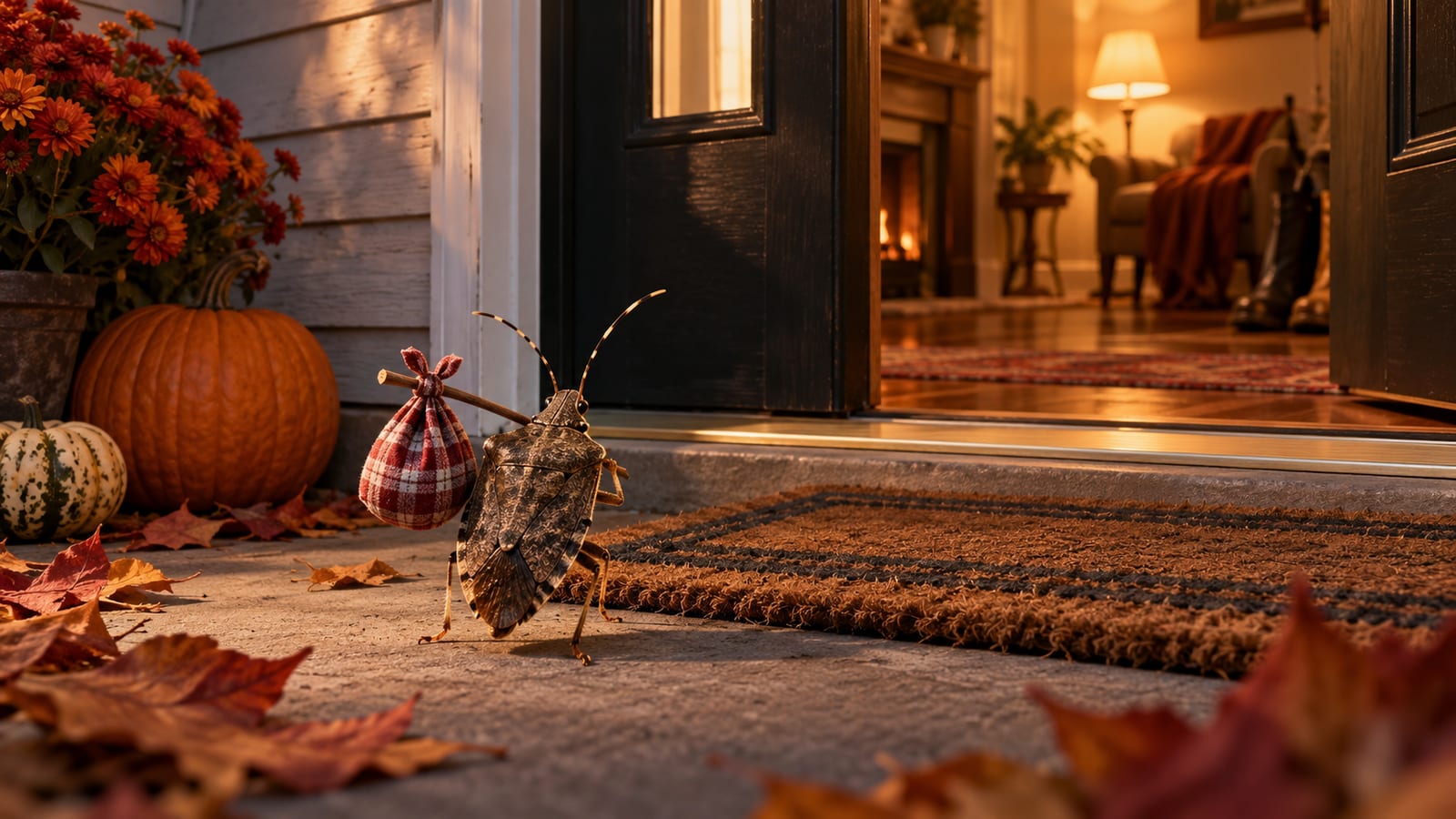
Once a bug lands, it may crawl toward an opening around siding, fascia, a window frame, a pipe, a vent or a chimney. From there it can disappear into a wall void or attic. Household warmth may stir some bugs during winter, which is why one can suddenly materialize beside a lamp or crawl across a curtain months after the main fall invasion.
This can feel like evidence of a thriving colony behind the drywall. It is not.
EPA and university extension guidance agree that brown marmorated stink bugs do not reproduce inside homes. They do not eat or bore into wood, and they do not cause structural damage. They do not bite people or pets, and EPA says they are not known to transmit disease. Some sensitive people may react to allergens from the insects, but for most households the problem is nuisance, numbers and smell.
About that smell
The odor is defensive. Threaten or crush the insect and it releases volatile chemicals intended to make a predator reconsider dinner.
Unfortunately, your shoe receives the same message.
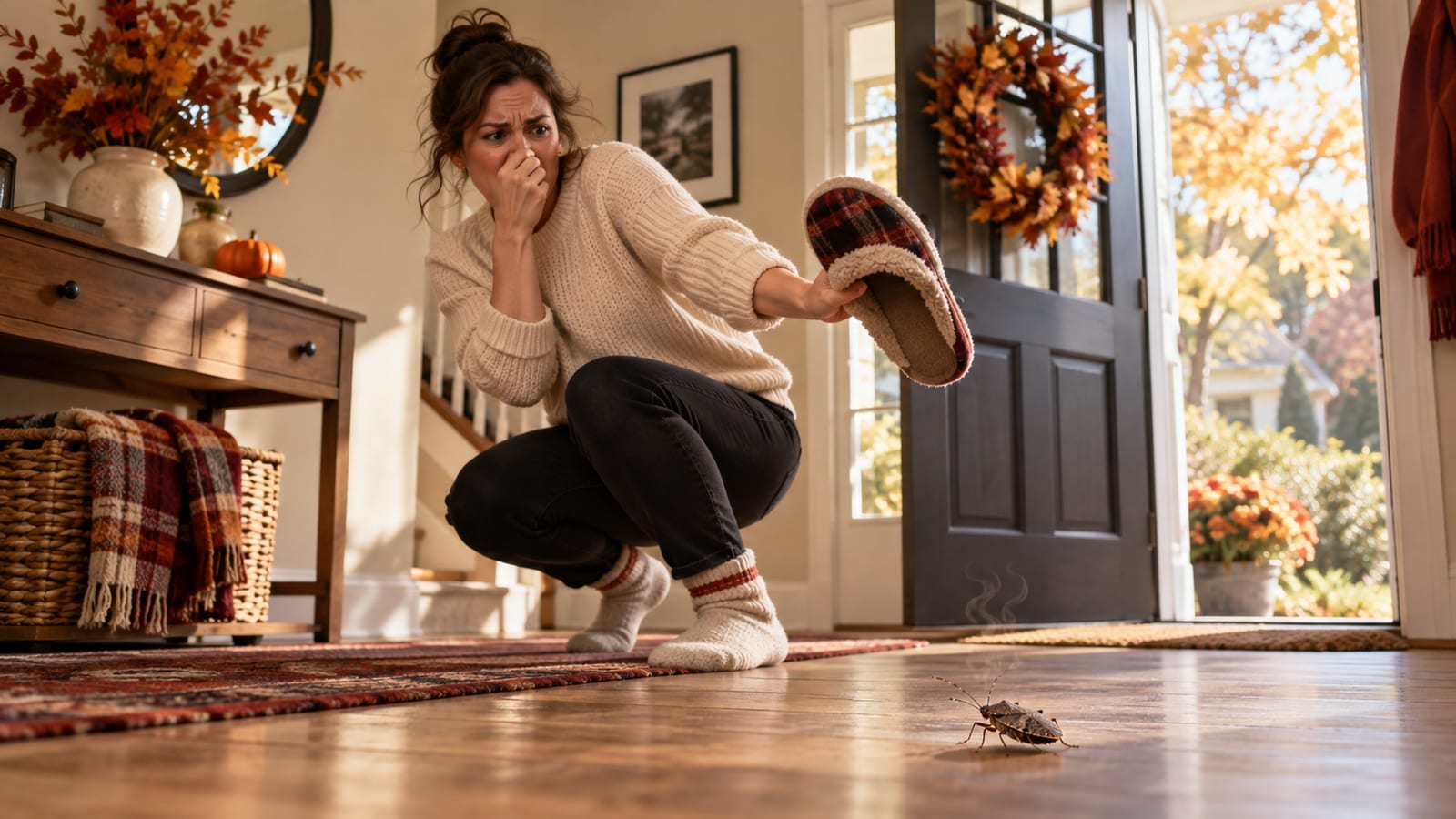
Avoid crushing them on walls, curtains or furniture. Besides producing the odor, that turns a simple removal job into a cleaning project. The smell from a disturbed bug is usually temporary, but a vacuum can retain it for a while.
The best defense, in order
The useful strategy is to stop the insects before they reach the hidden spaces in the building. Once they are inside a wall, no practical treatment can guarantee that another one will not emerge later.
1. Seal the building shell
Inspect the exterior before the fall migration. Seal cracks around windows, siding, fascia, foundation joints and utility penetrations with an appropriate exterior caulk or sealant. Pay particular attention to pipes, cables and other places where a small opening was left around something passing through the wall.
This is the highest-value step because it removes the route instead of trying to kill each traveler.
2. Fix the doors
Add or replace weatherstripping around exterior doors. Install a tight-fitting door sweep when daylight is visible beneath a closed door. A gap large enough to admit light is generous by stink bug standards.
3. Repair and screen openings
Repair torn window and door screens. Secure crawlspace entries and screen appropriate vents. EPA also recommends capping or screening chimney tops to keep pests out. Any chimney or ventilation work must preserve safe airflow and comply with local building and fire requirements.
4. Remove the window air conditioner
A window unit and its flexible side panels can create excellent entry points. Remove the unit for winter when practical. If it must remain, inspect and seal gaps around it without blocking required ventilation or drainage.

5. Collect the guests who got through
Vacuum individual bugs or sweep them into a container of soapy water. University of Maryland Extension suggests using a piece of cardboard or a small broom to make them drop into the container. If you use a vacuum, empty the captured insects promptly. Be prepared for the machine to smell temporarily.
Why bug bombs are a bad bargain
An indoor fogger can kill some bugs exposed in a living space. It cannot close the crack behind the baseboard, reach every insect hidden in a wall or prevent the next one from emerging after the pesticide dries.
EPA therefore says aerosol and fogger products are not a long-term solution for stink bugs. University of Maryland Extension also advises against spraying insecticide into indoor cracks and voids. Apart from unnecessary pesticide exposure, masses of dead insects inside walls may provide food for carpet beetles, creating a second pest problem with a much less amusing premise.
Routine exterior spraying has similar limitations. Sunlight degrades many products, mobile bugs can arrive after the residue loses effectiveness, and the openings remain available. A licensed professional may recommend a labeled, carefully timed exterior treatment for a severe recurring invasion, but spraying should be considered limited assistance, not a substitute for repair work.
The caulk gun still wins.
Could climate change bring them to more homes?
USDA Climate Hubs has summarized modeling that suggests rising temperatures could allow brown marmorated stink bugs to expand farther north and could increase survival and reproduction in some regions. That is a projection about the species' potential range and agricultural effects, not a promise that every household will experience larger invasions.
Local populations, surrounding vegetation, landscape and the condition of the building all matter. In a USDA-affiliated citizen science study, rural homes generally collected more bugs on their exteriors than urban homes, although substantial urban invasions can still occur.
For the individual homeowner, the advice remains pleasingly low-tech. Act before the insects disappear into the walls. Seal the cracks, fix the screens, tighten the doors and remove the window unit.
A brown marmorated stink bug may regard your house as excellent winter real estate. You are under no obligation to provide a vacancy.
Sources / further reading
- U.S. EPA: Brown Marmorated Stink Bug
- University of Maryland Extension: Tips for Dealing With Brown Marmorated Stink Bugs
- Penn State Extension: Common Urban Pests
- Hancock and colleagues: Presence of brown marmorated stink bugs on home exteriors
- USDA ARS: Phenology of brown marmorated stink bug
- USDA Climate Hubs: Climate Change Impacts on Brown Marmorated Stink Bug
- University of Maryland Extension: Brown Marmorated Stink Bug
- Ask Extension: Get Rid of Stink Bugs
Keep exploring


