How Close Are We Really to Bringing Back Extinct Mammals?
Cloned ferrets have produced new generations, and researchers are building increasingly capable genetic tools. The distance from those achievements to a restored extinct species depends on much more than DNA.

An extinct mammal has already been born through cloning. It died within minutes.
The animal was a bucardo, an extinct subspecies of Pyrenean ibex. Researchers had preserved cells from the last surviving female before she died. In 2003, they produced a clone; lung defects prevented it from surviving. The experiment appeared in a scientific journal in 2009. Original study, CITA's institutional history.
That brief life captures the difficulty hidden inside the phrase “bringing back.” Producing an animal, keeping it healthy, enabling it to reproduce and rebuilding a population are different achievements.
As of September 2026, some mammals can be cloned from preserved cells. Conservation clones have produced descendants. Researchers can also engineer living animals to express selected traits associated with extinct relatives. But the evidence does not establish a restored, self-sustaining population of an ancient extinct mammal.
The most revealing progress involves a small endangered carnivore whose genetic history spent decades in a freezer.
The clone that became a parent
In 2024, a cloned black-footed ferret named Antonia reproduced after mating with a male named Urchin. Of three kits born, two survived, according to the U.S. Fish and Wildlife Service. Antonia came from tissue collected in 1988 from a ferret called Willa. FWS's announcement.
The story continued in summer 2025: FWS reported 12 kits across four litters involving the clones Antonia and Noreen and Antonia's offspring, Sibert and Red Cloud. The descendants were reproducing too. These were new generations produced through breeding. FWS's subsequent update.
Why copy an animal when conservationists want genetic diversity? Because the value depends on which animal gets copied. Willa carried genetic variation unrepresented in the breeding population descended from seven founders. Her preserved cells offered a route for some of that variation to enter future generations. That does not establish that the descendants will survive disease better or thrive in the wild; those are further questions. FWS's account of the genetic rationale.
A similar strategy produced Kurt and Ollie, two Przewalski's horse clones born in 2020 and 2023. A peer-reviewed study published in 2025 describes their origin in cells banked in 1980 from a stallion whose lineage was underrepresented. Domestic horses supplied eggs and carried the pregnancies. The study established viable clones; it did not report their offspring. The horse cloning study.
Both projects concern species that still exist. They show how stored biological material can expand conservation's options before the last animal disappears.
A genome sequence cannot stand in for a cell
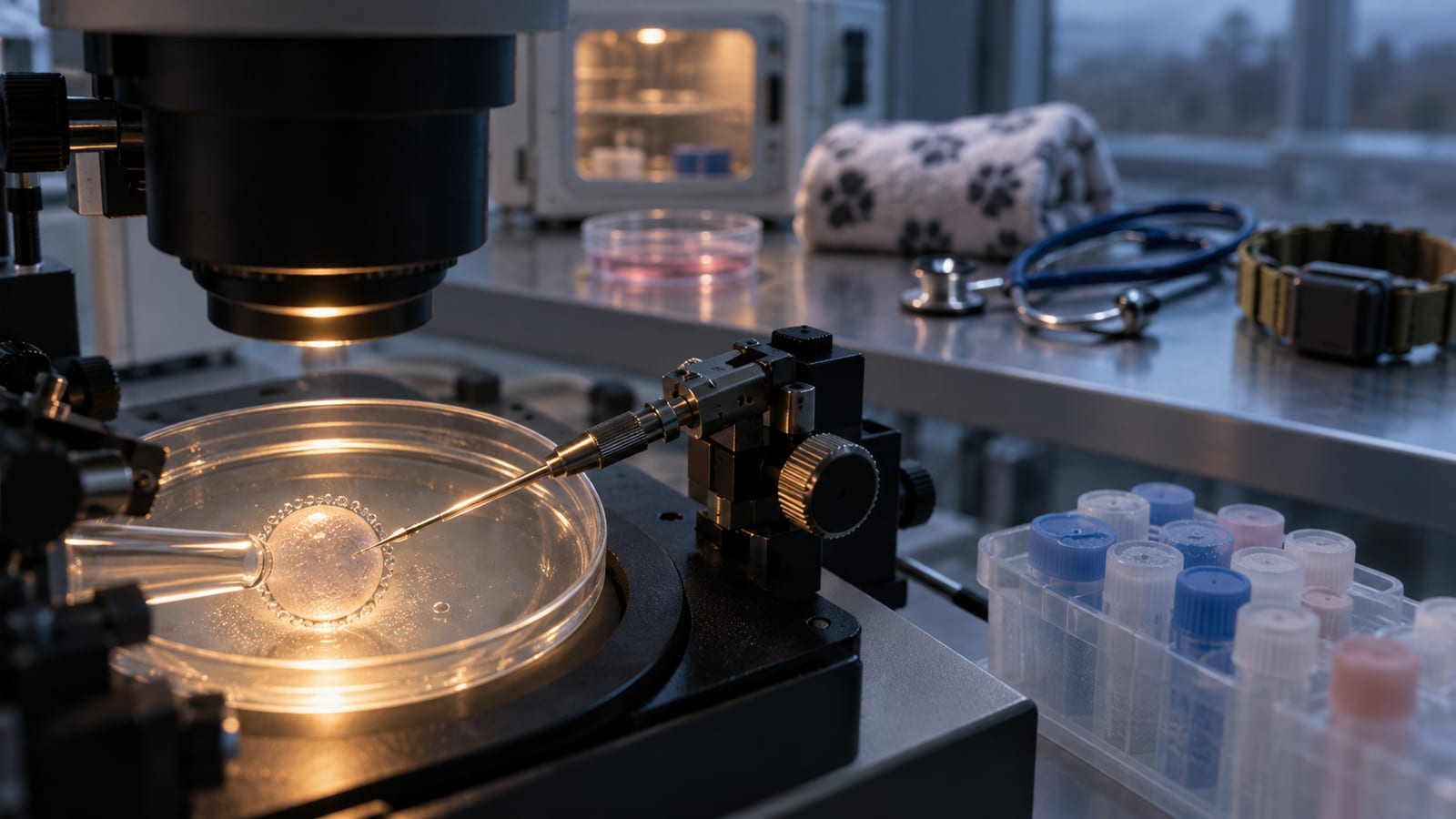
The basic cloning method is called somatic cell nuclear transfer. Scientists place a nucleus from a body cell into an egg whose own nucleus has been removed. If development succeeds, the animal carries essentially the donor's nuclear genome. The egg still supplies cellular machinery and mitochondrial DNA. The horse study's methods.

This makes the starting material crucial. A carefully preserved cell contains organized biological material that can support development. An ancient genome reconstructed from surviving DNA fragments is information assembled from remains. Sequencing does not turn that information into an intact, developmentally competent nucleus.
For ancient animals, researchers therefore pursue another route: compare genomes, identify potentially useful differences and edit cells from a living species. Those edited cells may then be used in reproductive procedures. A 2026 review by researchers involved in de-extinction projects describes this combination of genomics, cell engineering and assisted reproduction, and the reproductive technologies still under development. The review.
The resulting animal is an engineered proxy: a living organism intended to reproduce selected characteristics, and perhaps eventually ecological functions, of an extinct one. The IUCN has used that terminology in its conservation framework since 2016. IUCN's guiding principles.
That distinction explains the controversy around Colossal Biosciences' wolves. The company announced them in April 2025 as the return of the dire wolf. Its technical account describes 20 edits across 14 genes in gray-wolf cells. Editing and cloning can coexist in the same project: cloning reproduces the modified cell's nuclear genome. It does not make that genome a copy of an ancient animal. Colossal's account.
The IUCN SSC Canid Specialist Group acknowledged the technical achievement but described the animals as genetically modified gray wolves resembling an extinct species. It also challenged the claimed conservation justification. Resemblance is an outcome that can be studied; recovery of an extinct lineage is a much larger proposition. The specialist group's statement.
The scientific record has continued to develop. A Colossal-associated study published in Cell Genomics in 2026 reconstructed ancient dire-wolf genomes and proposed a complex ancestral history. That strengthens knowledge of the extinct animal. The paper concerns ancestry, however, and should not be presented as experimental proof that the engineered wolves restore the species. The paleogenomic study.
What the mammoth work actually shows
Two developments deserve attention beyond their publicity photographs.
First, researchers have engineered mice with combinations of altered hair traits. The work introduced publicly as woolly mice in 2025 subsequently appeared in Cell Reports Methods in August 2026. It demonstrates a way to combine genetic changes and investigate their effects in living animals. Its relevance to mammoths is as a research model; a mouse's coat does not establish that an elephant with corresponding edits would develop normally or tolerate an Arctic winter. Original preprint, 2026 paper.
Second, in June 2026 a Colossal-led team published the derivation of Asian elephant induced pluripotent stem cells. These are reprogrammed cells capable of producing multiple kinds of tissue. The researchers demonstrated differentiation into cell types representing the body's three principal embryonic tissue layers. They also reported a limitation: maintaining the cells' pluripotent state depended on introduced genetic constructs. The Nature Methods paper.
That is useful cellular biology. It is not a report of a mammoth embryo completing gestation, a calf being born or an adult reproducing.

Colossal has continued to give 2028 as its target for a first mammoth calf. That date is a company forecast. Its public claims about editing progress do not provide enough evidence to assign a reliable probability to the deadline. The company's 2026 account.
Related work illustrates why progress arrives in pieces. A 2025 study from researchers at the University of Melbourne and Colossal developed a more predictable way to obtain mature eggs from fat-tailed dunnarts, a living marsupial used in research relevant to the thylacine program. The eggs demonstrated development to an early embryo stage. That advances reproductive research in a living species; it does not document a restored thylacine. The dunnart study.
The difficult part continues after editing
Even with suitable donor cells, an egg must reset a specialized nucleus so that it can direct embryonic development. The placenta must function. The fetus must develop normally.
A 2024 rhesus-monkey study makes those obstacles tangible. Researchers identified abnormalities in the regulation of cloned genomes and in placental development. By replacing the embryo's placenta-forming tissue with tissue from a fertilized embryo, they obtained a cloned male that had survived for more than two years when the research was prepared. A successful result required solving a developmental problem beyond copying DNA. The Nature Communications study.
Other advances may make the starting material easier to obtain. A June 2026 study showed that particular cells isolated from blood could support conservation biobanking and cloning experiments. Gray-wolf embryos made from blood-derived cells produced six viable fetuses in the reported test. The endpoint matters: viable fetuses are encouraging evidence, but they do not establish six healthy, fertile adults. The Journal of Heredity study.
For an extinct-animal project, reproductive success would still leave questions about genetic diversity, behavior, habitat and ecological effects. An animal that looks convincing in a photograph has not thereby demonstrated that it can sustain a population or restore an ecosystem. Those are outcomes requiring their own evidence, the reason the IUCN's framework centers conservation benefit. IUCN's framework.
So there is no single countdown to bringing back extinct mammals. The answer depends on what survives of the animal, which living species can support the work and what “back” is supposed to mean.
The ferret descendants demonstrate something that a proposed mammoth birth date cannot: genetic material preserved decades ago can contribute to new generations. The next convincing de-extinction milestone will likewise need a precise description of what happened. A cell became an embryo. An embryo became a healthy animal. That animal reproduced. Its descendants survived.
Each of those would be worth a headline.
Sources / further reading
- Folch et al.: bucardo cloning experiment
- CITA Aragón: institutional history
- FWS: Antonia's offspring
- FWS: subsequent ferret generations
- Novak et al.: Przewalski's horse cloning
- Colossal: dire-wolf science
- IUCN SSC Canid Specialist Group statement
- Gedman et al.: dire-wolf ancestry
- Chen et al.: original woolly-mouse preprint
- Chen et al.: 2026 mouse engineering paper
- Appleton et al.: elephant stem cells
- Colossal: 2026 mammoth program account
- Liu et al.: dunnart reproductive research
- Liao et al.: rhesus-monkey cloning and placental development
- Knecht et al.: blood-derived cloning cells
- Hutchison et al.: de-extinction research review
- IUCN SSC: extinct-species proxy framework
Keep exploring


