Have aliens landed on Earth? There’s still no verified evidence
Military footage, sworn testimony and unusual metal fragments offer different kinds of evidence. None has established an extraterrestrial landing.

No alien landing on Earth has been established by publicly verified evidence. That is the answer supported by the public record reviewed for this article, as of September 13, 2026. NASA reports no evidence that unidentified anomalous phenomena, or UAP, are extraterrestrial; the U.S. government's historical review likewise found no empirical evidence for alleged reverse engineering of extraterrestrial technology. NASA’s position; AARO’s historical review.
That does not establish that a visit has never happened anywhere in Earth's history. It means the evidence does not justify answering yes.
A military recording can be authentic and its subject unidentified without establishing an alien spacecraft. One especially useful example shows how much can hide inside that distinction.
The Navy's January 2015 “Go Fast” video appears to show an object speeding over the ocean. AARO, the All-domain Anomaly Resolution Office, concluded in 2025 that the apparent speed resulted from motion parallax: movement of the observing aircraft changes how the object appears to move against the background.
The office still could not identify the object. Its assessment also acknowledged missing original recording metadata. The conclusion concerned the object's apparent performance, not a definitive name for it. Go Fast analysis.
That leaves a narrower mystery than a machine demonstrating impossible flight. An unknown identity does not make every proposed explanation equally supported.
This distinction extends beyond American military investigations. France's space agency, CNES, describes separate categories for sightings that lack enough data and sightings that remain unidentified after investigation. Those categories preserve uncertainty instead of assigning an origin. CNES’s GEIPAN overview.

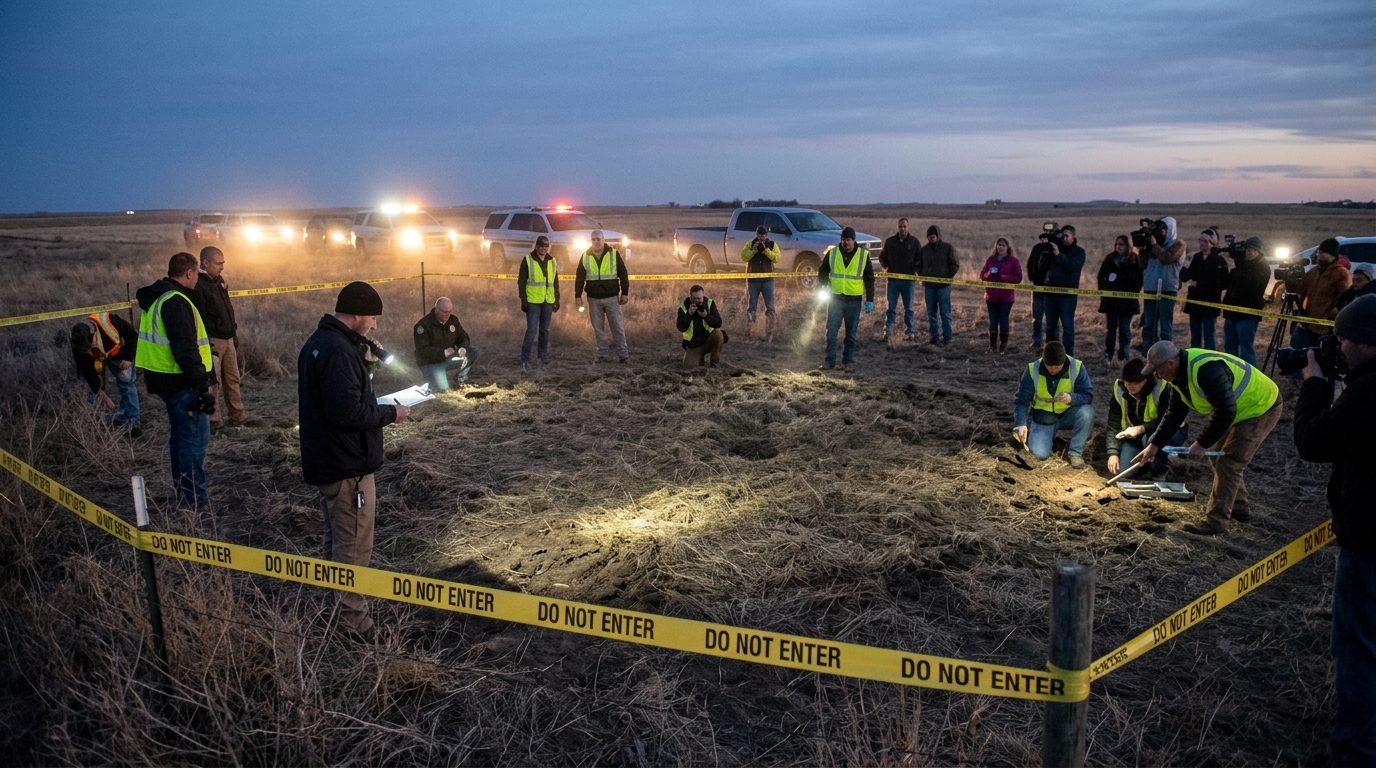
The unresolved cases are worth investigating. The mistake is treating the absence of an explanation as the discovery of one.
What about the testimony and recovered material?
At a July 2023 congressional hearing, former intelligence official David Grusch said recoveries had included biological material he described as “nonhuman.” He attributed that assessment to people with direct program knowledge whom he had spoken with. The exchange did not present a biological sample or laboratory analysis for public examination. Official hearing transcript.
Testimony can provide a serious lead. Establishing the origin of alleged remains requires evidence beyond the fact that someone testified about them. Nor does the word nonhuman, by itself, specify an extraterrestrial origin.
AARO's contrary findings deserve scrutiny too. An official report is evidence of what an investigation concluded; it does not let outside readers independently inspect every underlying classified record. We cannot settle that access problem by assuming either that hidden proof exists or that every allegation must be false.
Some physical claims, however, have reached the laboratory.
A metal specimen reportedly recovered in Ohio after a mid-1990s sighting was submitted for analysis. AARO's January 2026 account says the property owner reported seeing a large unidentified object before finding the material. That sequence is the reported provenance, not an established connection between the object and the metal. AARO’s specimen background.
Oak Ridge National Laboratory examined the supplied samples using chemical tests and imaging. It found an ordinary aluminum-silicon alloy, with structural features consistent with conventional casting. Its conclusion applies to those samples; it does not resolve every artifact claim. But this material did not supply the extraordinary evidence its story suggested. ORNL’s laboratory findings.

What the newer records change
AARO's FY2025 annual report, listed as released on July 20, 2026, describes 319 incoming reports. It says 114 of those were resolved as ordinary objects or events. Other cases remained open, including many without sufficient data. Its reporting period ended in May 2025, so these are not counts of sightings occurring in 2026. FY2025 report.
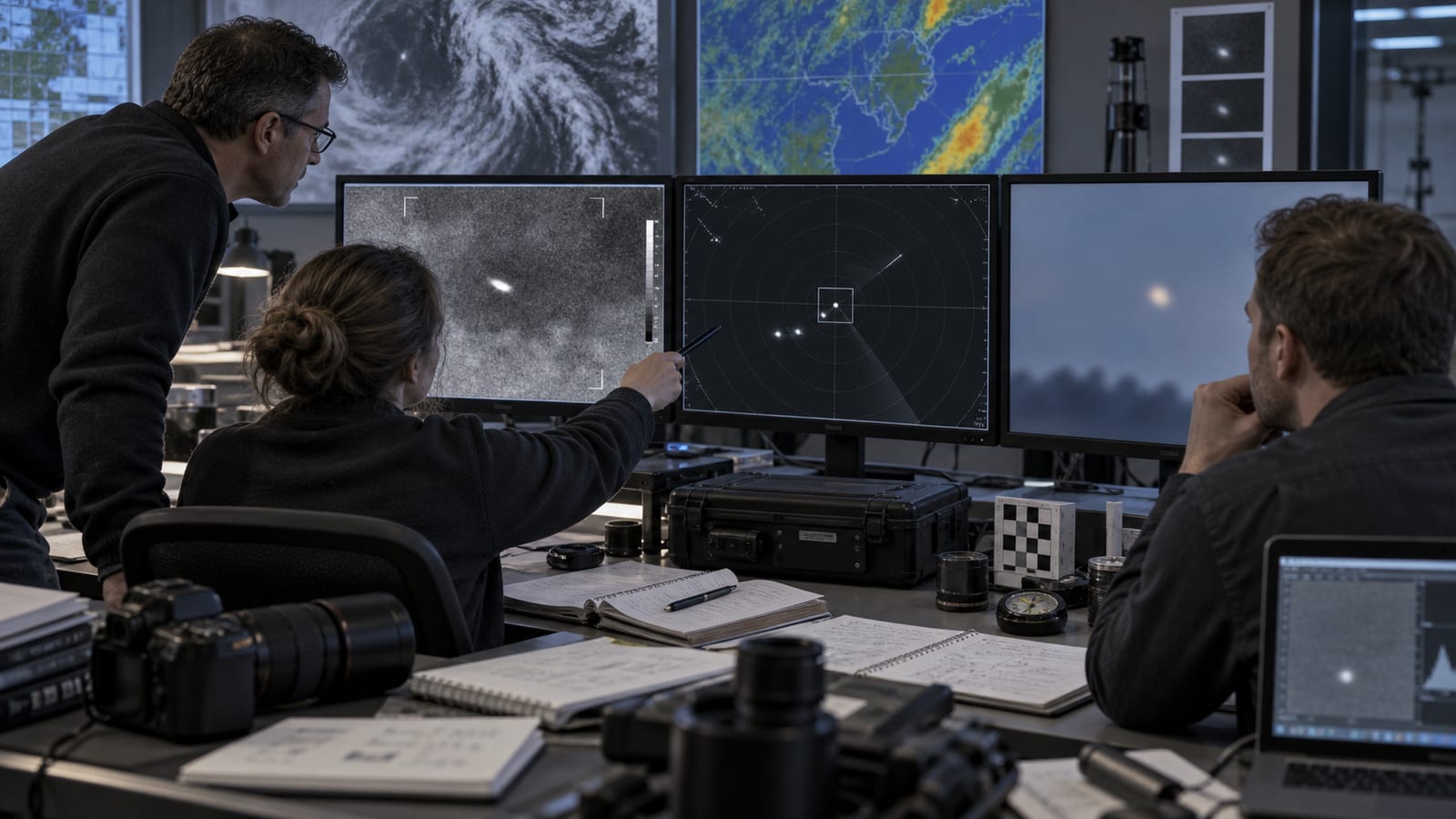
Newly released footage also needs its accompanying explanation. Among AARO's August 2026 releases are recordings made by pointing a device at a sensor display. The office flags the resulting image limitations and cautions that descriptions accompanying releases are not investigative conclusions. Making a recording public does not authenticate an extraterrestrial interpretation of it. AARO’s release descriptions.
NASA's 2023 scientific study identified the practical problem: investigators need observations good enough to test explanations. Calibrated instruments and corroborating measurements matter because an image that looks astonishing can leave basic questions about distance and movement unanswered. NASA study report.
For a landing claim, a persuasive investigation would need to connect the alleged event to evidence others could examine: original measurements, a documented recovery history, or material that survives independent testing. It would also need positive grounds for identifying an extraterrestrial origin. Simply failing to name an object would not supply those grounds.
Finding life elsewhere and establishing a visit here are separate discoveries. Either would be extraordinary. For the second, the decisive step would be making the evidence available so people who did not witness the event could check the conclusion for themselves.
Sources / further reading
Keep exploring


