We Can Make AI Sound Like a Whale. We Still Don’t Know What the Whale Is Saying
Scientists can identify hidden structures, generate lifelike calls and even hold responsive vocal exchanges with animals. A trustworthy translation is a much harder problem.

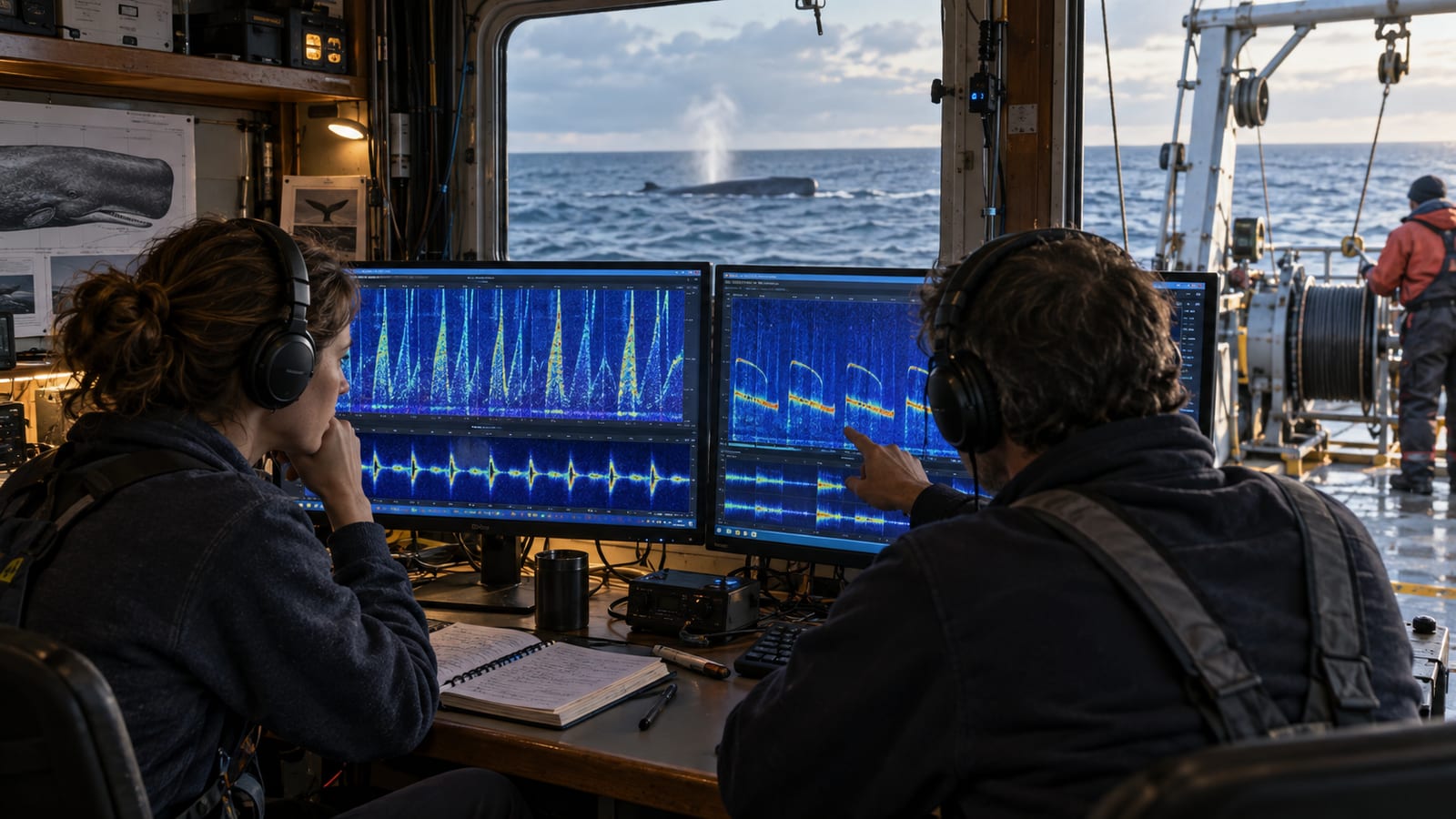
In 2025, researchers built an AI system that could produce convincing sperm-whale codas, the short bursts of clicks whales exchange while socializing. Trained with roughly 10,000 recordings, the model could imitate important acoustic features and generate new codas from an audio prompt.
Its name, WhAM, stood for Whale Acoustics Model. Its paper described it as a step toward a translative system.
But WhAM could not tell you what its clicks meant. There was no evidence that a whale would interpret a generated coda as “food over there,” “where are you?” or anything else. The system could produce something that sounded right without knowing what it was saying.
In other words, scientists had built the speaker before they had the dictionary.
That neatly captures where the effort to communicate with animals stands today. AI has pushed researchers much closer to finding structure in animal signals, identifying who is calling and participating in the mechanics of an exchange. For a few species, scientists have persuasive evidence about a small number of messages.
We are not close to a universal translator, or to asking a whale about its childhood and trusting the answer.
The missing subtitles
Translation between human languages works because meaning is already available. A system can train on millions of passages written in both English and Spanish. It can use dictionaries, corrected translations, photographs and feedback from people who speak the languages.
A sperm whale does not provide subtitles.
Researchers can record a click sequence, but the recording alone does not reveal whether it concerns the caller, the listener, the previous dive or an itch. Two calls may sound different because they convey different messages. They may also differ because the callers have different voices, belong to different social groups, are frightened, are moving at different speeds or were recorded with different equipment.
AI is exceptionally good at finding patterns among all that variation. It is not automatically good at telling researchers which patterns matter to an animal.
A 2026 Current Biology paper demonstrated the problem using a case in which humans have better access to meaning: calls made by pre-linguistic toddlers. Even there, similarity in the acoustic measurements did not reliably match the categories that listeners perceived. Clustering unfamiliar sounds can be useful, but the resulting clusters are not necessarily the animal’s words.
This is why the decisive experiment usually involves an audience with fur, feathers or fins. Researchers make a prediction about a signal, play it to an animal under controlled conditions and see whether the animal responds as predicted.
The animal grades the translation.
A bird-sized proof of meaning
Japanese great tits provide one of the clearest demonstrations.
The birds produce a sequence researchers label ABC when scanning for danger. They produce D notes to recruit other birds toward the caller. In playback experiments published in 2016, birds hearing ABC scanned their surroundings. Those hearing D approached the speaker. When researchers played ABC-D, the birds did both.
Then the researchers reversed the order. D-ABC contained the same pieces, but the birds rarely produced the combined response.


That experiment supports a narrow but powerful conclusion: the components carry information, their order matters, and the combination changes what the listener does. It does not establish that the birds possess English-like grammar. It does show what a credible step toward translation looks like.
Machine learning can accelerate the search for such signals. It can process years of audio, separate overlapping callers and find variations too subtle for a person to catalogue reliably. But the playback remains crucial because a statistical association is not yet a meaning.
Egyptian fruit bats make the distinction vivid. In 2016, researchers used machine learning to examine almost 15,000 vocalizations recorded during 75 days of social life. The calls contained information about who was speaking, whom the call was directed toward, the context and the likely outcome of the encounter.
That is an impressive amount of information to find in what human listeners might hear as a room full of furious squeaking. It still is not a bat-to-English transcript. A call associated with conflict could identify the opponent, reflect the caller’s arousal or influence the listener without naming the conflict at all.
Elephants may be calling names
A 2024 study of wild African savannah elephants moved further up the evidence ladder.
Researchers trained a model to predict the intended receiver of a rumble from its acoustic structure. They then played elephants calls that had originally been directed at them and, as controls, calls from the same caller directed at somebody else. The elephants responded differently when the call had been addressed to them.
The safest description is that these are individually specific, name-like calls. The evidence suggests they do not simply imitate the receiver’s own voice, which would make them especially interesting as possible learned labels.
But “name-like” is doing necessary work. Researchers have not shown that elephants use the label to gossip about an absent third elephant, for example. A 2025 correction fixed several errors in the playback data; the numerical results changed slightly, but their statistical significance and qualitative interpretation did not.
This combination, machine learning to discover a candidate pattern, field knowledge to form a hypothesis and playback to test the receiver, is probably what useful animal translation will look like for some time. It is slower than feeding recordings into a giant model. It is also much harder for an algorithm to bluff its way through.
Sperm whales have structure. Meaning is next.
Sperm whales are irresistible candidates for this work. They live in long-lasting, matrilineal social units, belong to cultural clans and exchange patterned sequences of clicks called codas.
A 2024 study analyzed 8,719 codas and found that whales varied them along at least four dimensions. Rhythm describes the relative spacing of clicks. Tempo describes a coda’s overall speed. Ornamentation adds an extra click. Rubato is a gradual change in timing that other whales can imitate during an exchange.
The combinations produced at least 143 frequently observed forms, far more expressive variation than the older inventory of coda types suggested.
Then, in 2026, researchers reported vowel-like spectral patterns in 3,948 codas from 15 whales. These patterns behaved in several ways that parallel features of human phonology, including categories resembling different vowel qualities and timing effects resembling coarticulation between neighboring sounds.
This is not evidence that sperm whales speak a disguised version of human language. The authors explicitly noted that they had not demonstrated what the contrasts mean. Phonology is about how a communication system organizes sound; semantics is about meaning. Discovering an alphabet-like set of pieces does not give you the dictionary, much less the literature.
Still, the structural work matters. Before researchers can ask what rubato communicates, they have to know rubato exists. AI has enlarged the number of testable hypotheses.
Can an AI already hold a conversation?
In one limited sense, yes.

A 2026 zebra-finch preprint describes more than 1,000 hours of recorded interactions containing over 1.5 million calls. Researchers built a generative model that responded to female finches in real time. The birds’ timing and acoustic adjustments during these exchanges resembled parts of their interactions with other birds more closely than they resembled responses to fixed recordings.
That is a genuine interactive exchange. It is also preliminary research, and it does not translate the exchange into propositions. The system learned when and how to answer in a finch-like fashion, not how to tell us what the conversation was about.
Humans can do a different kind of limited communication by teaching animals an artificial system. In a landmark 1984 experiment, two bottlenose dolphins learned acoustic or gestural symbols for objects and actions. They correctly followed unfamiliar instructions, including commands whose meanings depended on word order.
That showed remarkable comprehension. It did not decode the dolphins’ natural whistles. Teaching a dolphin our invented vocabulary is closer to establishing a shared set of commands than discovering its native language.
Together, these experiments reveal two routes that may eventually meet. Humans can learn more about animals’ natural signals, or humans and animals can build a new communication system together.
So how close are we?
The answer depends on what counts as talking.
Systems that detect a species, identify an individual or classify a broad behavioral context already exist. Narrow phrasebooks containing experimentally validated signals, danger, approach, individual identity and similar messages, exist for certain species. AI can make those tools faster and more sensitive.
Responsive machines that participate in the timing and sound patterns of an animal exchange are arriving now, although the most striking examples remain preliminary.
Reliable translation of a rich natural communication system is much further away. Open-ended conversation would require a model to distinguish what a signal refers to, how combinations change meaning, what the caller intends, how context alters the message and whether the animal understood the response. It would have to work on unfamiliar individuals and in new situations rather than memorizing correlations from one dataset.
No one can responsibly attach a date to that achievement. Progress will probably arrive as a collection of species-specific abilities rather than one magical animal app. An elephant system might first recognize who is being addressed. A bird system might distinguish warnings. A whale system might identify a clan, caller or conversational pattern. Those capabilities could be scientifically and practically valuable long before anyone translates a sentence.
There is also reason to move carefully. Playing an alarm call can frighten an animal. Faking an individual’s voice could interfere with relationships. A generative model may produce an acoustically plausible signal whose effect nobody anticipated. Researchers have therefore called for stronger validation and ethical safeguards as the technology becomes interactive, including in a 2023 Science perspective.
The first trustworthy animal translator will not be the model that produces the most persuasive English caption. It will be the one that repeatedly makes a precise prediction, sends a carefully controlled signal and receives the response that the prediction required.
That is not Doctor Dolittle. It is something less cinematic and more interesting: the beginning of a dictionary that the animals themselves get to correct.
Sources / further reading
- Contextual and combinatorial structure in sperm whale vocalisations
- The phonology of sperm whale coda vowels
- WhAM: Towards A Translative Model of Sperm Whale Vocalization
- African elephants address one another with individually specific name-like calls
- Author Correction: African elephants address one another with individually specific name-like calls
- Experimental evidence for compositional syntax in bird calls
- Everyday bat vocalizations contain information about emitter, addressee, context, and behavior
- Comprehension of sentences by bottlenosed dolphins
- Using machine learning to decode animal communication
- Leveraging AI-powered interactive playbacks to decipher rules of communication in zebra finches
- The challenge of decoding animal communication using AI
Keep exploring


