Which Is Actually Colder, Metal or Wood?
A metal cube and a wooden cube spent the night in the same room. The metal feels colder when you touch it. Is it?
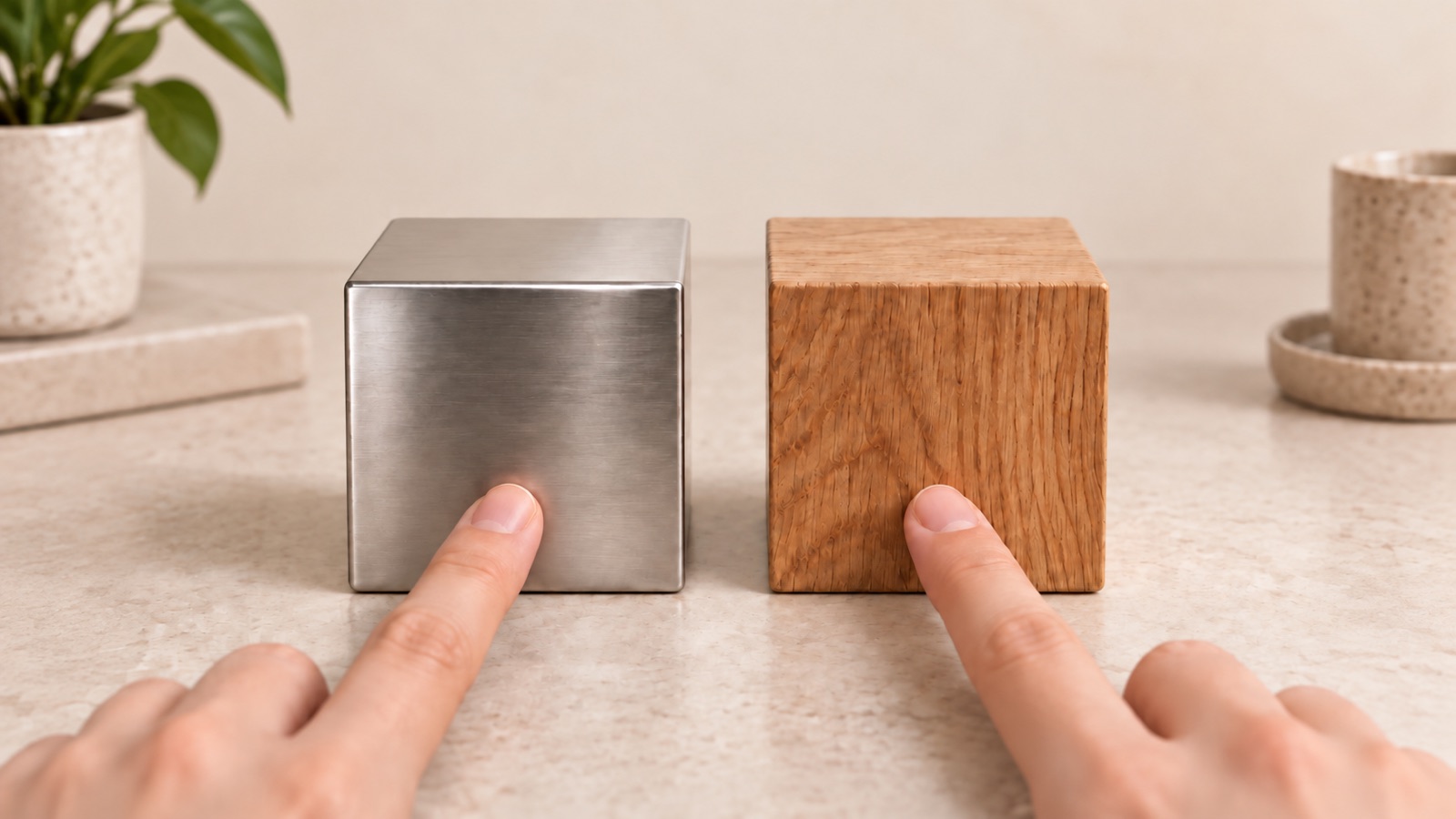
Lock in your answer
Go with your first instinct. Your choice is recorded anonymously in Google Analytics.
This puzzle feels easy because your hand seems to give you an immediate answer. Touch the metal, then the wood, and one sensation is stronger. The trap is assuming that your skin works like a thermometer.
It does not. Temperature is only part of what you feel. Your thermal receptors respond strongly to how quickly heat leaves or enters your skin. Two objects can therefore produce different sensations even when a thermometer gives the same reading.
The clue hidden in the room
The phrase “all night” matters. Objects left long enough in a stable room tend toward thermal equilibrium with their surroundings. That does not guarantee every microscopic point is perfectly identical, but it gives us the key condition for the puzzle.
Now picture your hand at roughly skin temperature touching an object in a cooler room. Heat flows from your warmer skin into that object. What changes from material to material is the speed of that transfer.
Why your first answer can feel so certain
Metals are good thermal conductors. Their mobile electrons help energy move rapidly through the material. Wood is a much poorer conductor because its structure contains many small air spaces and does not move thermal energy nearly as efficiently.
When your finger touches metal, heat is carried away from the contact area quickly. The skin temperature near that spot falls faster, so your nervous system reports a more intense cold sensation. Wood removes heat more slowly, so it feels warmer.
There is a related material property called thermal effusivity. In practical terms, it helps describe how strongly a material exchanges heat with something it touches. Metal typically has much higher thermal effusivity than wood, which is why the contrast can be so convincing.
Have your answer locked in? Here is the reveal.
C: They are approximately the same temperature.
After spending enough time in the same stable room, both objects are near room temperature. The metal feels colder because it draws heat from your skin faster, not because it started colder.
A simple way to test it
Place a metal utensil and a wooden utensil in the same room for several hours. First touch both. Then measure them with a contact thermometer that is suitable for surfaces. The readings should be close, while the sensations remain noticeably different.
The same principle explains why a tile floor can feel colder than a rug in the same room. Tile transfers heat away from bare feet more rapidly. The rug traps air and slows the transfer.
The effect can reverse when objects are hotter than your skin. A good conductor can deliver heat to your hand faster, which is why hot metal can feel dangerously hot so quickly.
What this teaches us
Our senses are not broken. They evolved to report changes that matter to the body. But the report is an interpretation, not a laboratory measurement. The sensation “cold” blends temperature, heat flow, contact area, pressure, moisture, and the recent thermal history of your skin.
That is the broader lesson behind this puzzle: a confident perception can be real while the explanation we attach to it is wrong. Good reasoning starts by separating what we experienced from what we concluded.